
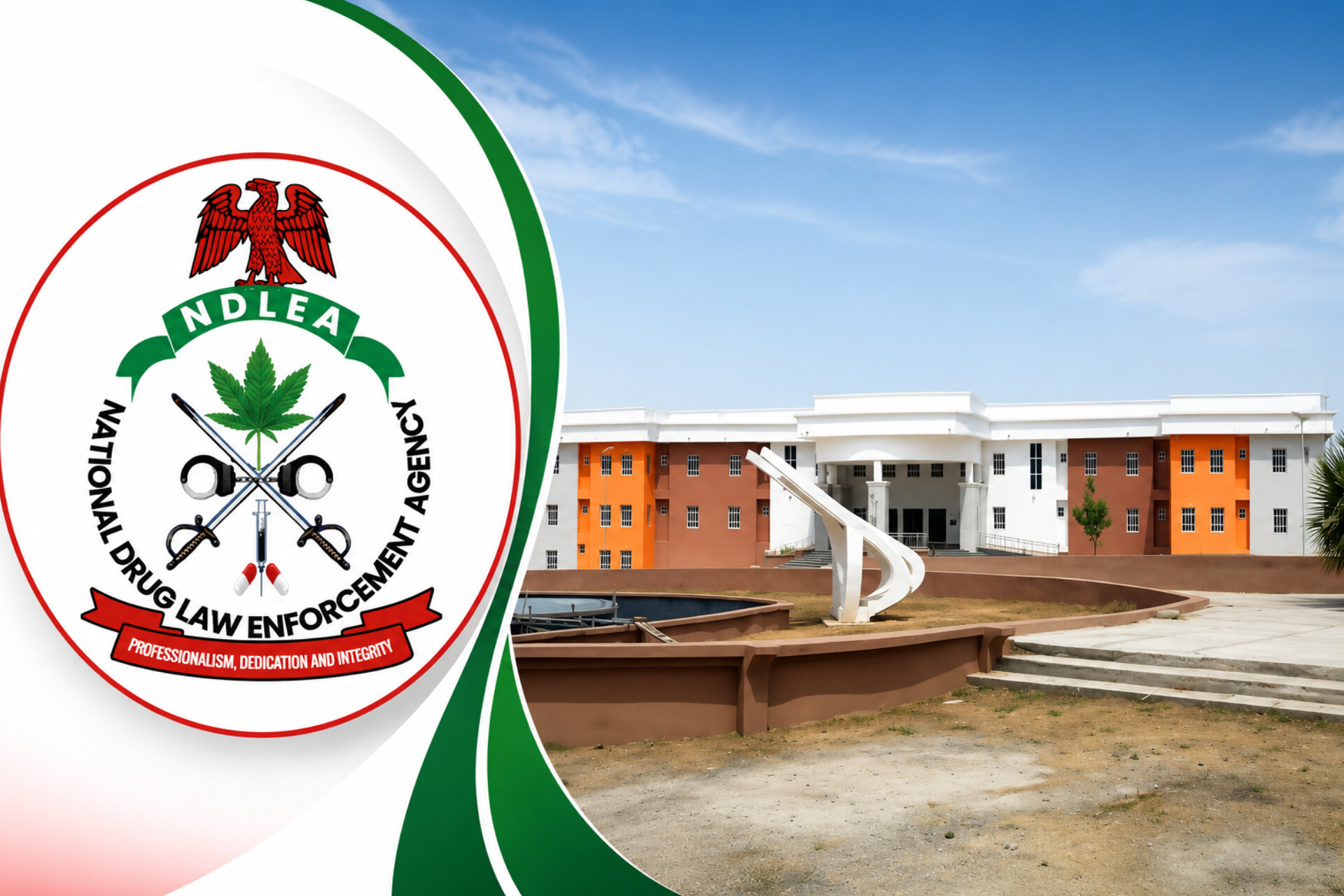
NDLEA Denies ‘Drug Bunker’ Discovery at Taraba Nursing College
The National Drug Law Enforcement Agency (NDLEA), Taraba State Command, has denied reports circulating on social media claiming that its operatives uncovered a suspected “drug bunker” at the Taraba State College of Nursing and Midwifery in Jalingo.
The agency said it neither conducted an operation at the institution nor issued any official statement announcing the discovery of a drug bunker within the college or its immediate surroundings.
The clarification follows the circulation of a social media publication alleging that the anti-narcotics agency had uncovered a suspected drug facility at the institution, a claim capable of raising serious concerns about the college, its students and management.
In an official clarification signed by the Command’s Public Relations Officer, ASN Mawoh Paul Voloh, on behalf of the State Commander, the NDLEA urged members of the public and media organisations to verify information before publishing or sharing reports attributed to law-enforcement agencies.
The Command maintained that photographs and narratives circulating online in connection with the alleged discovery should not be attributed to the NDLEA Taraba State Command.
NDLEA Says No Operation Took Place
At the centre of the controversy is a publication circulated on social media under a headline suggesting that the NDLEA had discovered a suspected drug bunker at the Taraba nursing institution.
Such a report could naturally generate public concern because it associates a health-training institution with alleged illicit drug activity while suggesting that a federal law-enforcement agency had conducted an operation there.
The NDLEA has now rejected that account.
According to the Command, there is no official record showing that its personnel carried out the alleged operation or discovered a drug bunker at the college or its immediate vicinity.
The agency also denied issuing a statement announcing such a discovery.
This clarification is significant because attributing an operation to a security or law-enforcement agency gives a report a level of official authority that can cause readers to accept the information as established fact.
Where the agency itself denies involvement, the original claim requires independent evidence before it can responsibly be presented as an NDLEA operation.
Circulating Photos Not From Command, NDLEA Says
The NDLEA also addressed photographs accompanying the social media narrative.
According to the Taraba State Command, the images and accompanying information being circulated should not be presented as material originating from the Command.
This aspect of the clarification highlights a growing challenge in the digital information environment.
Photographs can easily be detached from their original context and republished alongside unrelated claims. Without verification, an authentic photograph from one event can be used to create a misleading impression about another location, institution or incident.
The existence of a photograph, therefore, does not automatically prove the accompanying narrative.
Verification requires establishing where and when an image was taken, who produced it and whether the organisation being credited with the information has actually confirmed the event.
In this case, the NDLEA has explicitly distanced its Taraba Command from the photographs and narrative associated with the alleged nursing college operation.
College Risks Reputational Damage
The agency warned that circulating the claim could wrongly associate the Taraba State College of Nursing and Midwifery, including its management, staff and students, with illicit drug activities.
That concern goes beyond correcting the name of the law-enforcement agency involved.
Educational institutions depend significantly on public confidence.
A claim suggesting that a “drug bunker” exists within a college could affect how prospective students, parents, professional bodies and members of the wider public perceive the institution.
Students could also face unfair assumptions despite having no connection to the alleged activity.
For that reason, allegations involving criminal activity require a high level of verification before publication.
This is especially important when an allegation concerns an identifiable institution or group of people.
Once inaccurate information spreads widely across social media, correcting the public impression can be considerably more difficult than preventing the misinformation from spreading in the first place.
Anti-Drug Operations Are Ongoing in Taraba
While denying the specific claim involving the College of Nursing and Midwifery, the NDLEA made clear that its anti-drug activities across Taraba State are continuing.
The Command said it is conducting operations under Operation Restore Order, an initiative focused on identifying, disrupting and dismantling illicit drug activities and trafficking networks.
The agency also reaffirmed its statutory responsibility to combat drug abuse and illicit drug trafficking across Taraba, with particular concern for the impact of drug abuse on young people.
This distinction is important.
The fact that the NDLEA is conducting operations elsewhere in Taraba does not mean every report, photograph or enforcement claim circulating online can automatically be linked to the agency.
Individual operations still require confirmation.
The Command’s clarification effectively separates its genuine ongoing anti-drug campaign from the specific social media allegation concerning the nursing college.
Media Organisations Urged to Verify Claims
The incident also raises important questions about verification in news reporting.
The NDLEA urged media organisations and members of the public to confirm information with the relevant authorities before publishing or sharing reports concerning law-enforcement operations.
For journalists, verification is particularly important when a story attributes an operation, arrest, seizure or statement to an official agency.
An effective verification process can involve contacting the agency’s authorised spokesperson, checking its official communication channels and seeking documentary or direct confirmation before presenting a claim as fact.
This is increasingly necessary because social media allows information to spread far faster than traditional verification processes.
A dramatic claim can reach thousands of people within minutes, particularly when accompanied by photographs or videos.
However, speed does not make information accurate.
For professional news organisations, publishing an incorrect report quickly can create greater reputational damage than publishing a verified report later.
Why Attribution Matters
The controversy demonstrates why precise attribution is an essential part of responsible journalism.
If a report says the NDLEA discovered something, readers reasonably understand that the agency conducted the operation or officially confirmed the discovery.
Where that attribution is false, the report does more than contain an ordinary factual error. It gives unsupported information the authority of a federal law-enforcement agency.
The consequences can be serious.
An institution can suffer reputational harm, individuals can become targets of suspicion, and public confidence in legitimate law-enforcement communications can be weakened.
False attribution can also create confusion during genuine security operations because members of the public may struggle to distinguish official information from fabricated or misleading reports.
The safest approach is therefore to clearly identify what has been independently confirmed and what remains an allegation.
Public Should Treat Viral Claims With Caution
The NDLEA’s clarification provides a useful reminder that viral information should not automatically be regarded as verified news.
Users should pay particular attention to claims involving arrests, criminal investigations, security agencies and educational institutions.
Before sharing such reports, it is useful to determine whether the organisation named in the story has actually confirmed the information.
A screenshot carrying a logo or photograph is not necessarily an official statement.
Similarly, a post claiming that an agency conducted an operation does not become authentic simply because multiple accounts have repeated it.
Repeated misinformation remains misinformation unless supported by credible evidence.
In the nursing college case, the relevant agency has now publicly rejected the attribution.
NDLEA Reaffirms Anti-Drug Commitment
Despite distancing itself from the alleged discovery, the NDLEA Taraba State Command says it remains committed to combating drug abuse and trafficking throughout the state.
Operation Restore Order will continue to target illicit drug activities and trafficking networks as part of the agency’s wider enforcement responsibilities.
The Command’s position is therefore not that drug-related enforcement has stopped in Taraba. Rather, it is that the specific operation being attributed to its personnel at the Taraba State College of Nursing and Midwifery did not originate from the Command.
Until credible evidence establishes otherwise, reports claiming that the NDLEA Taraba State Command uncovered a “drug bunker” at the college should not be presented as an official NDLEA operation.
The episode also reinforces an important standard for the media and social media users: serious allegations should be verified before publication, particularly when they can damage the reputation of individuals or institutions.
For ClearFact News, the key verified position from the available information is straightforwardthe NDLEA Taraba State Command has denied conducting the alleged operation and has warned against attributing the circulating photographs and narrative to the agency.
