
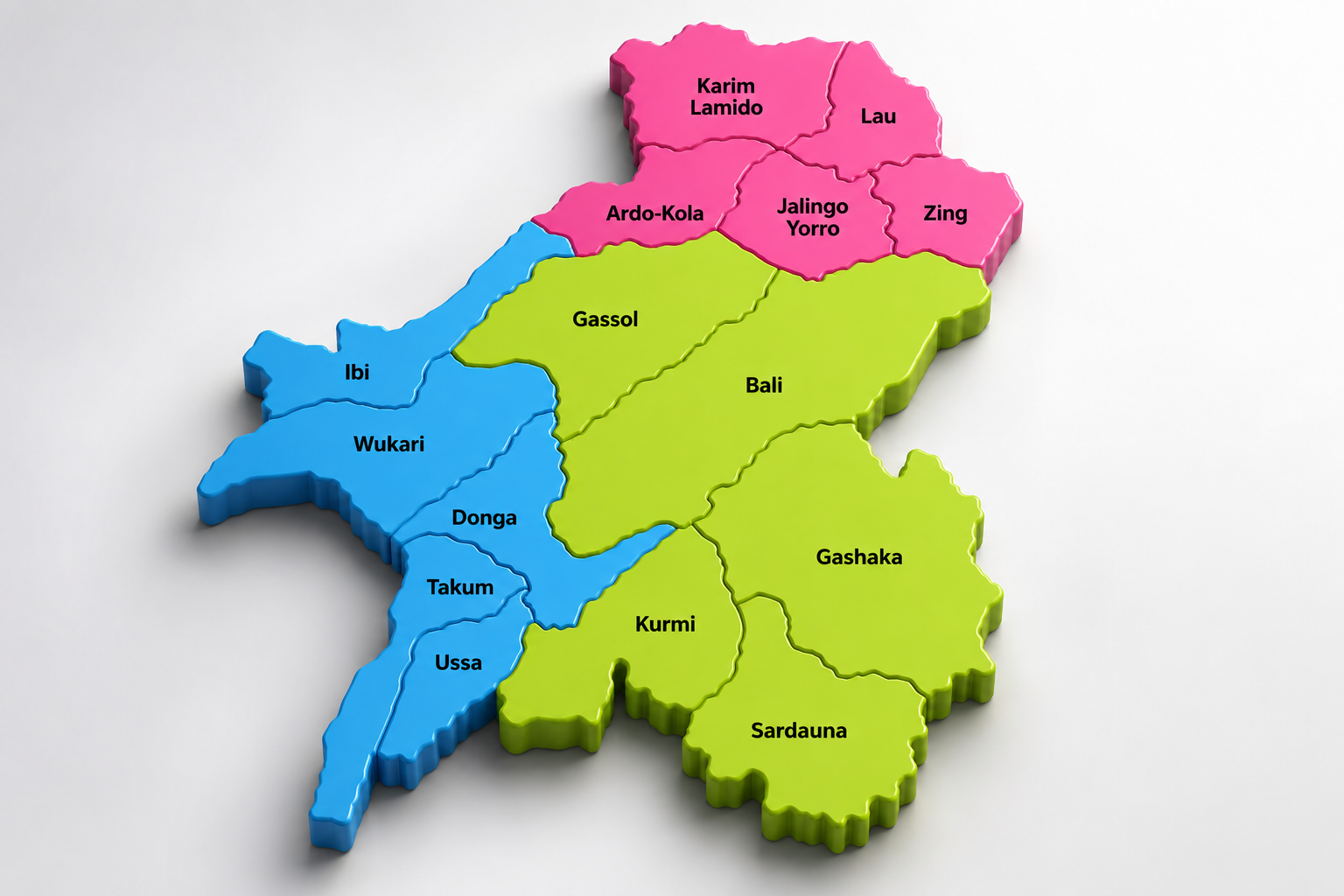
Taraba at 35: Beyond Celebration, the Questions That Matter
Thirty-five years after its creation, Taraba State stands at an important point in its history — one that calls for more than celebration. It is also a moment for reflection on the journey so far, the opportunities that remain untapped and the kind of state its people want to build for future generations.
Created on August 27, 1991, Taraba emerged with enormous promise. The state is endowed with fertile land, abundant natural resources, mountains, diverse cultures and a youthful population. These attributes have helped earn it the popular description, “Nature’s Gift to the Nation.”
But after 35 years, the bigger question is whether these advantages have been sufficiently translated into development that improves the everyday lives of the people.
Anniversaries naturally provide opportunities to celebrate achievements. They are also useful moments for honest assessment. Taraba’s journey since 1991 has included progress in different areas, but important development challenges remain.
One of the most pressing is infrastructure.
Roads, electricity, water supply, healthcare facilities, schools and other basic infrastructure remain fundamental to economic and social development.
Successive administrations have made interventions in these areas, but the development needs across the state remain considerable.
More importantly, development must not be concentrated in Jalingo or other major urban centres while rural communities struggle with inadequate infrastructure.
A farmer in a remote community should be able to transport produce to the market. Children in rural areas should have access to functional schools. Families should be able to access healthcare without travelling unreasonable distances, while communities should have access to safe water and other essential services.
The presence of government should be felt beyond the state capital.
Infrastructure is therefore not simply about constructing physical projects. It is about connecting people to opportunities and improving their quality of life.
Another major issue for Taraba at 35 is human capital development.
No society can sustainably develop beyond the capacity of its people.
Taraba’s youthful population can become one of its greatest advantages, but only if young people have access to education, skills, entrepreneurship and opportunities that prepare them to participate meaningfully in the economy.
Education must consequently go beyond preparing young people to search for government employment.
The state needs a generation capable of creating businesses, solving problems, developing new ideas and generating employment.
Technical skills, entrepreneurship and innovation should form an important part of that transformation.
Young people should be equipped to participate in agriculture, technology, the creative economy and other productive sectors instead of waiting indefinitely for limited government vacancies.
Human capital development is particularly important because Taraba’s natural resources cannot transform the state on their own. Land, minerals, forests and other resources become economically meaningful when people possess the knowledge, skills and institutions required to use them productively and responsibly.
Agriculture is another major issue that deserves serious attention.
Taraba possesses vast arable land and produces significant quantities of food, yet many farmers remain economically vulnerable.
That contradiction should form part of the state’s development conversation at 35.
The future of agriculture must extend beyond subsistence production.
Greater emphasis is needed on modern farming, irrigation, storage, agro-processing and value addition.
Producing agricultural commodities without developing the capacity to process them means losing opportunities for employment and additional income.
Farmers should increasingly participate in value chains that allow them to earn more from what they produce.
Storage facilities can help reduce losses. Processing can increase the value of agricultural commodities. Better market access can improve farmers’ earnings, while irrigation can reduce excessive dependence on seasonal rainfall.
If properly developed, agriculture can become a stronger engine of economic transformation rather than merely a means of survival.
Taraba should not continue exporting its economic potential in raw form while finished products and the jobs associated with their production are created elsewhere.
Security and peaceful coexistence represent another fundamental concern.
Development cannot flourish where communities live in fear or where recurring conflicts destroy livelihoods and weaken relationships.
Taraba’s diversity should be treated as an asset rather than a source of division.
The state is home to numerous ethnic groups, languages, religious communities and cultural traditions. Properly harnessed, this diversity can contribute to a richer and stronger society.
Government, traditional institutions, religious leaders, civil society organisations and citizens all have responsibilities in preventing communal conflicts, protecting lives and strengthening trust among communities.
Peace must not be regarded solely as the responsibility of security agencies.
Communities themselves have an important role in rejecting violence, promoting dialogue and ensuring that disagreements do not escalate into conflicts capable of reversing years of development.
A fifth issue is accountability and responsible leadership.
At 35, Taraba must strengthen the principle that public resources belong to the people.
Government institutions should therefore operate with transparency, prudence and responsibility.
Citizens, on the other hand, have the right and responsibility to ask legitimate questions about governance and demand accountability.
Constructive scrutiny should not be interpreted as hostility to government. A healthy society benefits when citizens take an interest in how public resources are managed and when public officials recognise that leadership is fundamentally about service.
Political leadership should never become primarily a pathway to personal enrichment.
Those entrusted with public office carry a responsibility to use public resources to advance the collective interest.
But Taraba’s future cannot depend exclusively on whoever occupies Government House.
Development is bigger than government.
The private sector, professionals, traditional rulers, religious institutions, academics, civil society organisations, diaspora communities and ordinary citizens all have roles to play.
Political differences should not prevent people from supporting initiatives capable of advancing the state.
Taraba needs a culture in which elections can be contested vigorously but development remains a shared objective after political campaigns are over.
The state also needs leaders capable of thinking beyond the next election and citizens willing to think beyond the next political appointment.
The next phase should be about building institutions and opportunities that can endure beyond individual administrations.
The vision should be clear: a Taraba where a child living in a rural community can receive quality education; where farmers can earn decent incomes from their labour; where young people can find opportunities to develop their potential; and where women can participate fully in economic life.
It should be a state where healthcare is accessible, communities are connected by good roads and citizens can live and pursue their livelihoods without fear.
Achieving such a Taraba will require more than slogans.
It will demand political will, visionary leadership, accountability, unity and collective commitment.
Taraba does not lack potential. The challenge is converting that potential into prosperity that ordinary citizens can see and experience.
Thirty-five years of statehood should therefore not only produce memories of the past. It should create a stronger determination to build a better future.
The anniversary offers an opportunity to celebrate progress while recognising that much remains to be done.
The next 35 years must be defined by stronger institutions, productive agriculture, improved infrastructure, better opportunities for young people, peaceful coexistence and responsible leadership.
As Taraba marks this milestone, perhaps the most important question is not simply how far the state has travelled since 1991.
The question that matters most is this: What kind of Taraba are we building for the next generation?
