
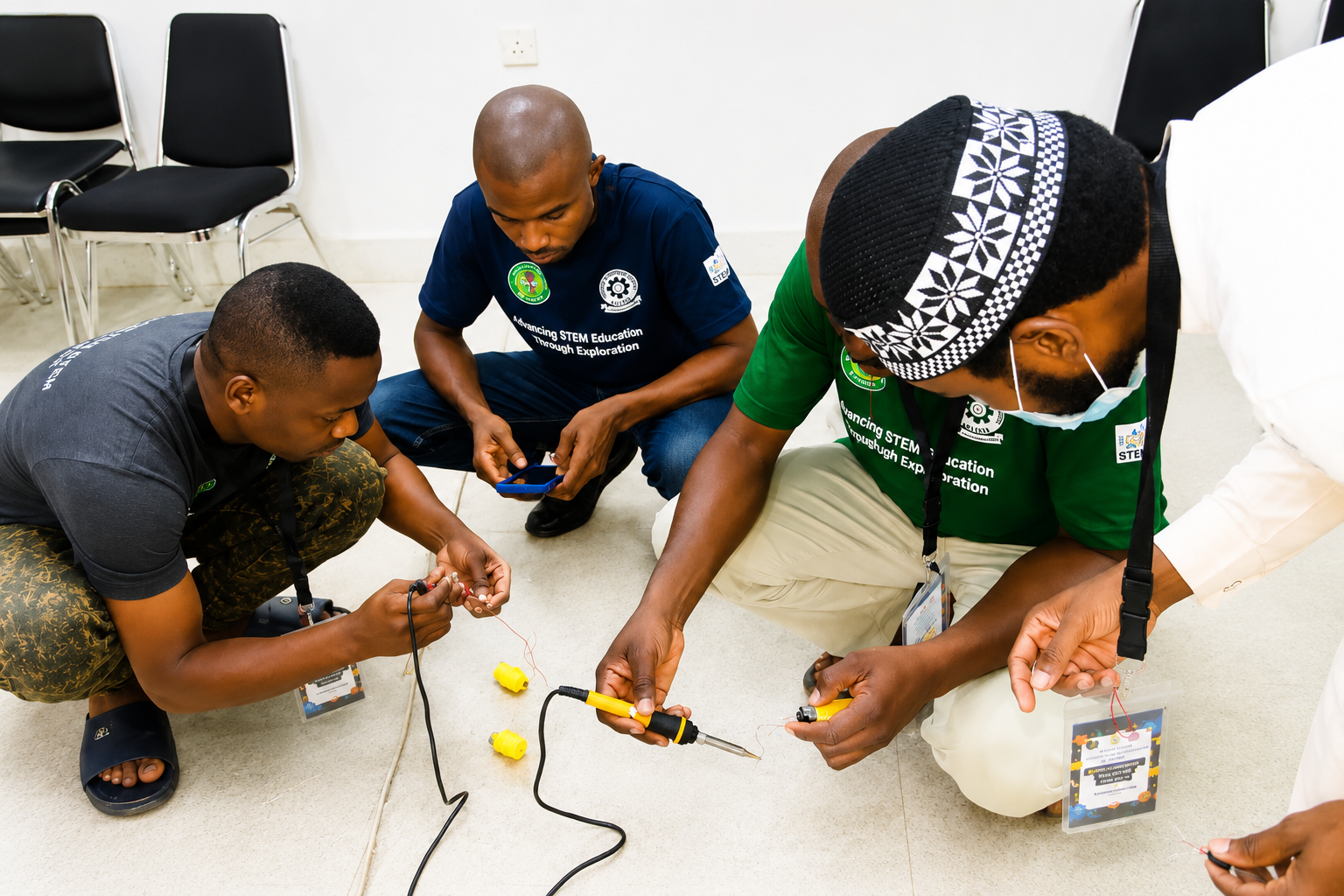
Taraba Trains 16 Teachers in Space Exploration, STEM Education
The Taraba State Government has trained 16 teachers in space exploration and Science, Technology, Engineering and Mathematics education as part of efforts to strengthen science teaching and expose students to emerging areas of knowledge.
The training reflects growing efforts to improve the capacity of teachers to deliver practical and engaging science education while preparing young people for opportunities in technology, innovation and space-related disciplines.
The initiative focused on equipping participating teachers with knowledge and teaching approaches that can help them introduce students to space science and strengthen interest in STEM subjects.
Teachers remain central to the success of any educational reform because investments in laboratories, technology and learning materials can only achieve their intended impact when educators have the skills required to use them effectively.
By training teachers first, the initiative creates an opportunity for knowledge acquired during the programme to be transferred to students in their respective schools.
The 16 participants are therefore expected to serve as important links between the training programme and the wider student population.
Space exploration may appear distant from the everyday experiences of many students, but its underlying disciplines are closely connected to subjects already taught in schools.
Mathematics, physics, geography, computer science, engineering and environmental studies all contribute to understanding space science and its practical applications.
Satellite technology, for example, has become increasingly important to communication, weather monitoring, navigation, agriculture, disaster management and environmental observation.
Introducing students to these connections can help them understand that science is not simply a collection of theories studied for examinations but a tool for solving real-world problems.
The training is also significant because of the increasing importance of STEM skills in the modern economy.
Technology continues to transform industries and workplaces, creating demand for people with strong analytical, scientific and digital capabilities.
Students who develop an early interest in science and technology may be better positioned to pursue further education and careers in engineering, computing, geospatial technology, aviation and other specialised fields.
Teachers play a critical role in developing that interest.
A student who sees science only as difficult formulas may struggle to appreciate its possibilities. But when teachers connect classroom lessons to practical examples, experiments and real-world applications, students can begin to see science differently.
Space exploration provides an especially powerful platform for stimulating curiosity.
Questions about satellites, planets, rockets, the atmosphere and the wider universe can encourage young learners to investigate scientific concepts beyond what they encounter in textbooks.
That curiosity can become a pathway into broader STEM education.
The initiative therefore has potential value beyond the immediate number of teachers who participated.
If each trained teacher transfers the knowledge acquired to students and colleagues, the impact can extend to a much larger group.
This multiplier effect is one of the major advantages of teacher capacity-building programmes.
However, sustained impact will depend on what happens after the training.
Participants will need opportunities to apply what they learned in their classrooms. Schools may also require suitable instructional materials and continued institutional support to make STEM learning more practical.
Training teachers without creating opportunities for implementation could limit the long-term benefits of the programme.
For this reason, integrating acquired knowledge into regular teaching activities will be important.
Students should be encouraged not only to learn scientific concepts but also to ask questions, experiment, observe and develop solutions.
Practical activities can make science more engaging and help learners understand concepts that may otherwise appear abstract.
The initiative also highlights the importance of preparing Taraba’s education system for technological change.
The careers available to today’s students are increasingly different from those available to previous generations.
Fields such as artificial intelligence, robotics, geospatial science, satellite technology and data analysis are becoming more relevant to governments, businesses and research institutions.
Preparing students for such opportunities requires a strong foundation in mathematics, science and digital literacy.
Teacher development must therefore evolve alongside these changes.
Educators need continuous exposure to new knowledge and modern instructional approaches if they are to prepare students for a rapidly changing world.
Programmes focusing on STEM and space exploration can contribute to this process by broadening teachers’ understanding of emerging scientific fields.
For Taraba State, strengthening STEM education could also contribute to solving local development challenges.
Science and technology have applications in many of the sectors on which the state’s economy and communities depend.
Agriculture can benefit from satellite observations and modern data systems. Environmental monitoring can use remote sensing technologies. Surveying and mapping increasingly depend on satellite positioning systems, while weather information can help communities make better-informed decisions.
Exposing students to the science behind these technologies can demonstrate how knowledge acquired in school connects directly with development.
The training of 16 teachers may represent a relatively small beginning, but its significance will depend on the extent to which the knowledge spreads beyond the original participants.
The teachers can become advocates for stronger STEM education within their schools, encouraging colleagues and students to embrace scientific learning and innovation.
Schools can further strengthen the initiative by creating science clubs and encouraging practical projects where resources permit.
Competitions, demonstrations and student-led experiments can also help sustain interest.
Another important consideration is inclusion.
Efforts to expand STEM education should provide opportunities for both boys and girls to participate meaningfully.
Encouraging girls to develop confidence in science, technology, engineering and mathematics can expand the pool of young people capable of contributing to future scientific and technological development.
Students in rural communities should also have opportunities to benefit from science education initiatives.
Taraba’s geography means educational opportunities can differ considerably between urban centres and remote communities.
Expanding teacher training across different parts of the state could help reduce such gaps and ensure that interest in STEM is not limited to a small number of schools.
The long-term value of the initiative will ultimately be measured by outcomes.
If trained teachers are able to make science more engaging, increase student participation and stimulate greater interest in STEM careers, the programme could provide a foundation for broader educational transformation.
It could also encourage students to look beyond traditional career paths and explore emerging opportunities in science and technology.
Space exploration itself is built on curiosity, research, experimentation and innovation — qualities that are equally valuable in the classroom.
By introducing teachers to the field, Taraba is creating another avenue through which these qualities can be passed to young learners.
The challenge now is to sustain the momentum.
Regular capacity building, adequate teaching resources and opportunities for practical learning will be necessary to ensure that the programme produces lasting results.
For the 16 teachers who participated, the responsibility extends beyond completing a training programme. They now have an opportunity to transfer their knowledge to classrooms and inspire students to see science as a pathway to discovery, innovation and future opportunity.
As Taraba continues efforts to strengthen its education sector, investment in teachers will remain critical.
The success of the state’s students in an increasingly technology-driven world will depend not only on access to education but also on whether they are exposed to the knowledge and skills required for the future.
The training in space exploration and STEM education is a step in that direction, placing teachers at the centre of efforts to inspire the next generation of scientists, innovators and problem-solvers.
