
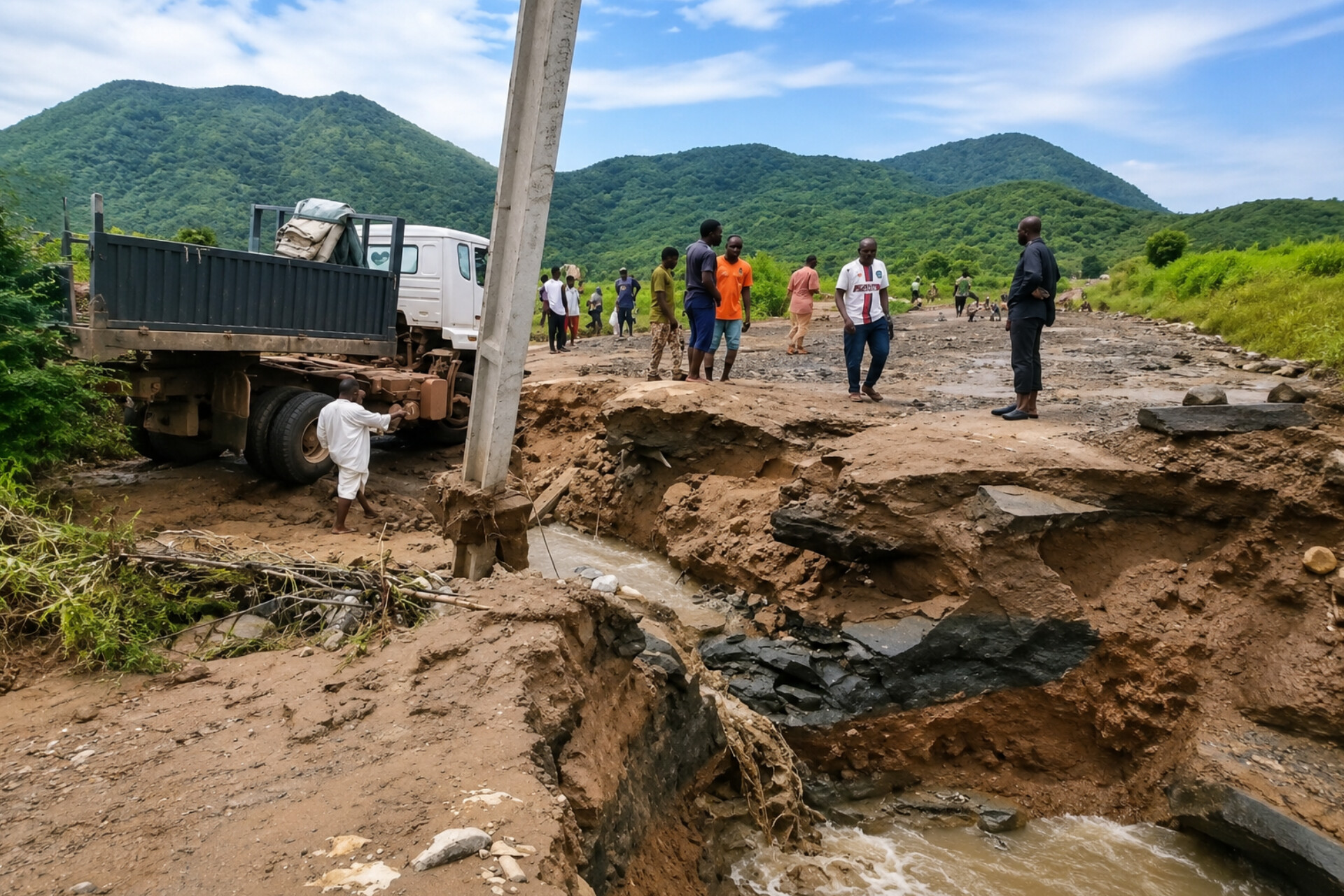
Taraba at 35: Bad Roads Still Choking Growth, Cutting Off Communities
Thirty-five years after Taraba State was created, poor road infrastructure remains one of the biggest obstacles standing between many communities and the economic opportunities needed to improve livelihoods across the state.
From Yorro and Lau to Karim Lamido, Kurmi and Ussa, residents continue to contend with difficult road conditions that affect movement, agriculture, trade and access to essential services.
The situation is particularly troubling because Taraba possesses enormous agricultural, tourism and commercial potential. Yet for many communities, moving people and goods from one location to another remains difficult, expensive and, in some cases, dangerous.
As the state marks 35 years since its creation, the condition of its roads raises a fundamental development question: how much progress can Taraba realistically achieve when communities producing food and other economic resources remain poorly connected to markets and urban centres?
A 35-Year Infrastructure Challenge
Taraba was created on August 27, 1991, with expectations that statehood would accelerate development and bring government closer to communities.
More than three decades later, progress has been recorded in several areas, but road infrastructure continues to expose major development gaps.
The challenge is not restricted to one senatorial district or local government area.
Communities across different parts of the state continue to experience poor road access, while critical corridors connecting towns and rural settlements require rehabilitation or reconstruction.
For residents, this is not simply an infrastructure debate.
A bad road affects the price of food.
It affects how quickly a pregnant woman reaches a hospital.
It determines whether farmers can transport produce before it spoils.
It influences whether businesses can move goods at reasonable cost.
It can even determine whether teachers, healthcare workers and other professionals are willing to accept postings to remote communities.
That makes road infrastructure central to almost every serious conversation about Taraba’s development.
Farmers Pay a Heavy Price
Agriculture is one of Taraba’s strongest economic assets, but poor transportation infrastructure continues to limit the benefits many farmers can derive from their work.
Across the state, rural communities produce rice, maize, yam, cassava, vegetables and other agricultural commodities.
Producing food, however, is only one part of the agricultural economy.
Farmers must also move their harvests from farms to communities and from communities to larger markets.
When roads are in poor condition, transportation becomes more expensive.
Drivers factor damaged roads, longer travel times, vehicle maintenance and increased fuel consumption into their charges.
Farmers and traders ultimately absorb those additional costs.
For producers of perishable commodities, the consequences can be even more severe. Delays in transporting produce to markets can result in losses before goods reach buyers.
This means a farmer can record a successful harvest and still struggle financially because getting that harvest to market is too difficult or expensive.
Communities Risk Being Cut Off
The challenge becomes particularly severe during the rainy season.
Roads that may be manageable during the dry months can become extremely difficult after heavy rainfall, leaving some communities struggling to maintain reliable links with surrounding towns.
The condition of strategic routes around areas such as Zagah and Namnai has become part of the wider concern over connectivity in the state.
Similar concerns stretch into communities in Ussa, Kurmi, Yorro, Lau and Karim Lamido.
Where bridges, culverts and connecting roads deteriorate, communities face more than uncomfortable journeys.
Economic activities slow down.
Transportation costs rise.
Travel times increase.
Emergency movement becomes more difficult.
The effects can spread across entire local economies.
Bad Roads Are an Economic Problem
Road infrastructure should not be viewed only as a transportation issue.
It is fundamentally an economic issue.
Businesses are more likely to thrive where goods and customers can move efficiently.
Farmers become more competitive when transportation costs are lower.
Investors are more likely to consider locations where infrastructure allows them to operate efficiently.
Tourism also depends heavily on accessibility.
Taraba possesses some of Nigeria’s most remarkable natural attractions, but tourism potential cannot be separated from the ability of visitors to reach destinations safely and conveniently.
Poor connectivity can therefore prevent communities from benefiting from resources and opportunities that already exist around them.
The cost is difficult to calculate because it includes investments that never arrive, businesses that never expand and agricultural products that never reach their most profitable markets.
The Federal Roads Question
Not every troubled road in Taraba falls directly under the state government’s control.
Some strategic routes are federal roads, meaning responsibility for rehabilitation may involve the Federal Government.
But for residents travelling on them, jurisdiction provides little comfort when a road becomes difficult to use.
One important corridor is the Numan–Mayo Belwa–Jalingo route, which provides a major connection into Taraba and links the state with neighbouring Adamawa.
Its condition has repeatedly highlighted the importance of reliable interstate transportation corridors to Taraba’s economy.
The distinction between federal and state responsibility is administratively important, but addressing the infrastructure deficit will require coordination rather than prolonged arguments over ownership.
Where a federal road deteriorates, the economic consequences are still felt by residents of the state.
Roads Must Connect Development
Taraba’s infrastructure challenge also goes beyond repairing isolated sections of damaged roads.
The state needs a road network that connects agricultural communities to markets, communities to healthcare facilities, students to schools and businesses to commercial centres.
Building a good road without addressing a failed bridge along the same corridor can leave the wider transportation problem unresolved.
Similarly, rehabilitating urban roads while productive rural communities remain inaccessible may improve movement within towns without fully unlocking the state’s agricultural potential.
Infrastructure planning therefore needs to focus on connectivity.
The objective should not simply be the number of kilometres constructed but the economic and social opportunities those kilometres unlock.
Accountability Must Follow Road Projects
Another important issue is the quality and durability of road construction.
Taraba cannot afford infrastructure projects that begin to deteriorate shortly after completion.
Road contracts require transparent procurement, proper engineering standards, effective supervision and accountability.
Residents should also be able to know which roads have been awarded, the contractors handling them, the value of the projects and expected completion dates.
That information allows communities, journalists and civil society organisations to follow public projects and demand explanations when implementation falls behind schedule.
Infrastructure development requires huge public expenditure. Every poorly executed project represents resources that could have improved the lives of thousands of people.
Taraba’s Next 35 Years Must Look Different
Thirty-five years after state creation, Taraba has reached a point where celebrations must be accompanied by serious assessment.
The state possesses enormous resources.
It has fertile agricultural land, tourism potential, mineral resources and a population capable of driving economic growth.
But infrastructure determines whether those advantages can be converted into prosperity.
A farmer in a productive rural community should not lose income simply because the road to the nearest market is nearly impassable.
A medical emergency should not become more dangerous because an ambulance cannot move quickly through a damaged corridor.
Businesses should not spend unnecessarily on vehicle repairs and transportation because critical roads have deteriorated.
Taraba’s road crisis is therefore not merely about potholes, broken bridges or uncomfortable journeys.
It is about development.
As the state enters another chapter of its history, the measure of progress should be whether communities that have waited decades for reliable connectivity finally begin to see meaningful change.
At 35, the question is no longer whether Taraba needs better roads.
The question is how quickly governments at the state and federal levels can turn repeated promises, budgets and projects into durable roads that connect people to opportunities.
Until that happens, bad roads will continue to do more than slow vehicles.
They will continue to slow Taraba itself.
