
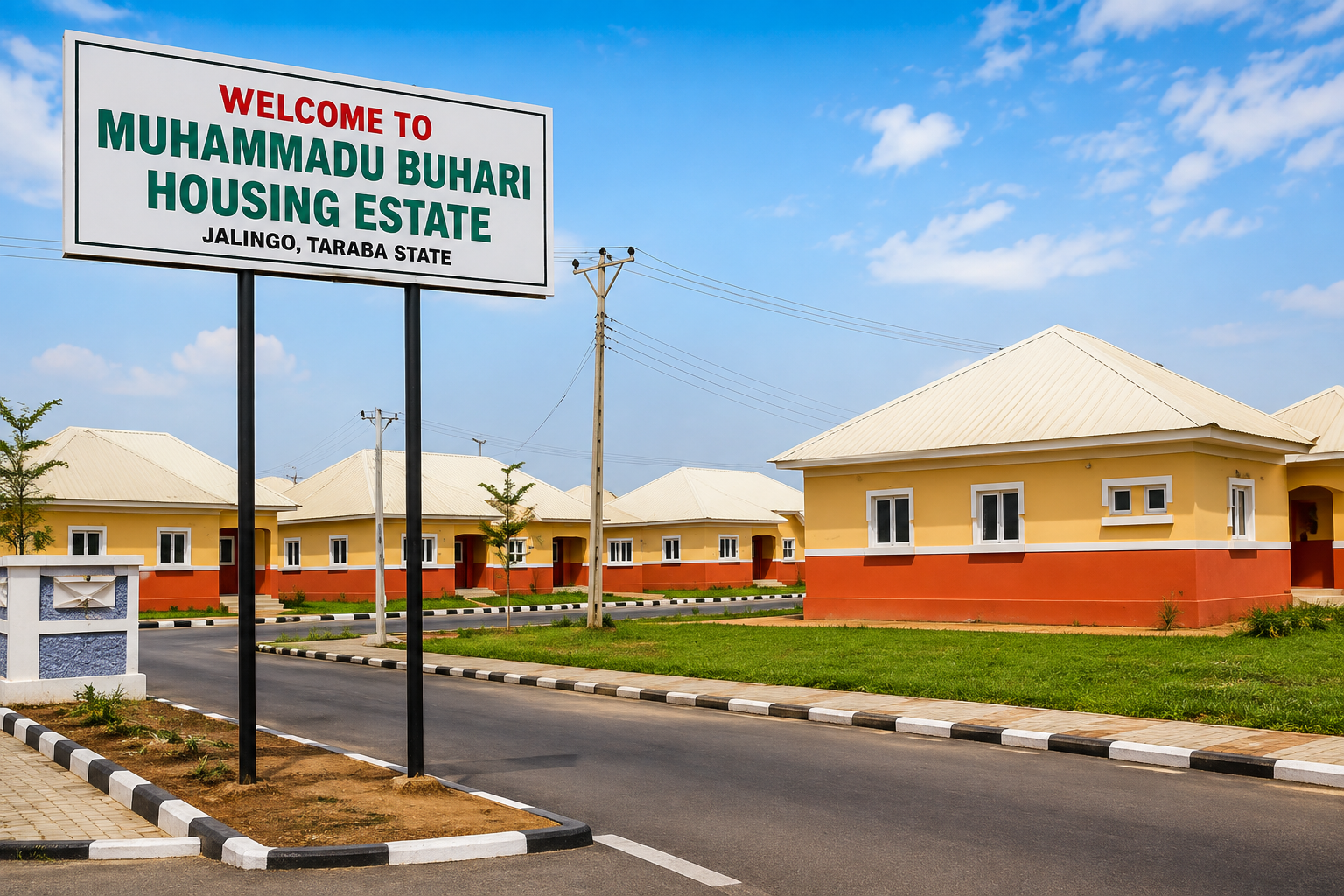
FG Hands Over Muhammadu Buhari Housing Estate to Taraba Government
The Federal Government has formally handed over the Muhammadu Buhari Housing Estate in Jalingo to the Taraba State Government, transferring responsibility for the facility to the state and opening a new phase in its administration and utilisation.
The handover represents a significant development for the estate, particularly as the Taraba State Government considers how available public infrastructure can be deployed to address housing, security and other development priorities.
The formal transfer took place at the Executive Council Chambers in Jalingo, with the Minister of Housing and Urban Development, Engr. Muttaqha Rabe Darma, representing the Federal Government during the exercise.
With the handover completed, the Taraba State Government is expected to exercise greater administrative control over the housing estate and determine how the facility can best serve the state’s immediate and long-term needs.
The development comes against the backdrop of recent security and institutional changes in Taraba State, including the establishment of the 10 Division of the Nigerian Army in Jalingo.
The Muhammadu Buhari Housing Estate had been among facilities considered for temporary accommodation and operational support for personnel of the newly established Army Division pending the development of permanent facilities.
The estate was also inspected by officials of the Taraba State Government and the pioneer General Officer Commanding the 10 Division following his arrival in Jalingo.
These developments have increased attention on the strategic importance of the facility and the role it could play beyond its original housing purpose.
By formally transferring the estate to the Taraba State Government, the Federal Government has effectively placed decisions concerning its future administration and deployment within the control of the state.
The transfer could provide the state government with greater flexibility in determining how the estate should be utilised in response to existing priorities.
While housing remains a major development challenge across Nigeria, the emergence of new security requirements in Taraba has also created demand for suitable accommodation and operational facilities.
The establishment of a new Army Division naturally requires supporting infrastructure, particularly during the period before permanent military facilities are fully developed.
Against this background, the housing estate could become an important asset in the state’s broader planning.
However, the formal handover does not automatically determine the final use of the facility. Decisions regarding its deployment will ultimately depend on the priorities and arrangements adopted by the Taraba State Government.
The development also comes at a time when the Federal Government is pursuing wider reforms and partnerships aimed at expanding access to housing across the country.
The Minister of Housing and Urban Development has repeatedly emphasised the importance of cooperation among the Federal Government, state governments and credible private investors in addressing Nigeria’s housing deficit.
Such partnerships are increasingly important because the scale of the country’s housing challenge requires more than direct construction by the Federal Government alone.
State governments have a major role to play in providing land, facilitating infrastructure, improving planning systems and ensuring that completed housing projects are effectively managed.
Private-sector participation can also bring investment, construction capacity and innovative financing arrangements into the housing market.
For Taraba State, the transfer of the Muhammadu Buhari Housing Estate therefore presents both an opportunity and a responsibility.
The state now has greater authority over a significant public asset, but effective utilisation will require careful planning and transparent management.
Public housing projects can deliver considerable social and economic benefits when properly administered. They can expand access to accommodation, support urban development, create economic activities and provide infrastructure for public institutions.
Poorly managed facilities, on the other hand, can remain underutilised despite substantial public investment.
The challenge for the Taraba State Government will therefore be to ensure that the estate contributes meaningfully to the state’s development objectives.
One immediate consideration is the relationship between housing and the state’s changing security architecture.
The establishment of the 10 Division of the Nigerian Army in Jalingo represents a major institutional development for Taraba.
Beyond its security implications, the presence of a major military formation creates demand for accommodation, transportation, utilities and other supporting services.
Providing suitable temporary facilities could help the new division become operational while permanent infrastructure is being developed.
At the same time, any decision regarding the use of a public housing estate must take into account the broader purpose for which the facility was developed and the housing needs of residents.
This makes long-term planning particularly important.
Taraba, like many states across Nigeria, continues to experience population growth and increasing demand for decent accommodation, especially in urban centres such as Jalingo.
Housing development is closely linked to other aspects of urban growth, including roads, electricity, water supply, drainage, schools, healthcare and commercial activities.
A well-managed housing estate can therefore become more than a collection of residential buildings. It can contribute to the emergence of organised communities and stimulate economic activity around its location.
The handover also highlights the importance of coordination between federal and state authorities in managing public assets.
Projects initiated by the Federal Government ultimately operate within states and communities where local authorities have direct responsibility for many supporting services.
Closer cooperation can help prevent completed facilities from remaining idle because of disagreements over ownership, management or responsibility.
The transfer of the Muhammadu Buhari Housing Estate provides Taraba with an opportunity to integrate the facility into its wider development planning.
Whether the estate is eventually deployed principally for housing, security-related accommodation or another public purpose, its utilisation will be closely watched because of the public resources invested in its development.
The Federal Government’s broader housing policy has increasingly emphasised collaboration with states and private investors as part of efforts to improve access to decent and affordable accommodation.
For Taraba, the immediate task is to translate the transfer of ownership and administrative responsibility into productive use.
Effective management, maintenance and transparent allocation will be important in ensuring that the estate does not become an underutilised government asset.
The handover therefore marks more than a ceremonial transfer between two levels of government. It places responsibility for the future of the estate firmly in the hands of the Taraba State Government and creates an opportunity for the facility to contribute to the state’s housing, security and broader development priorities.
As the government determines the next phase for the estate, attention will now shift from ownership to utilisation and from the formal handover to the tangible benefits the facility can deliver to Taraba State and its people.
