
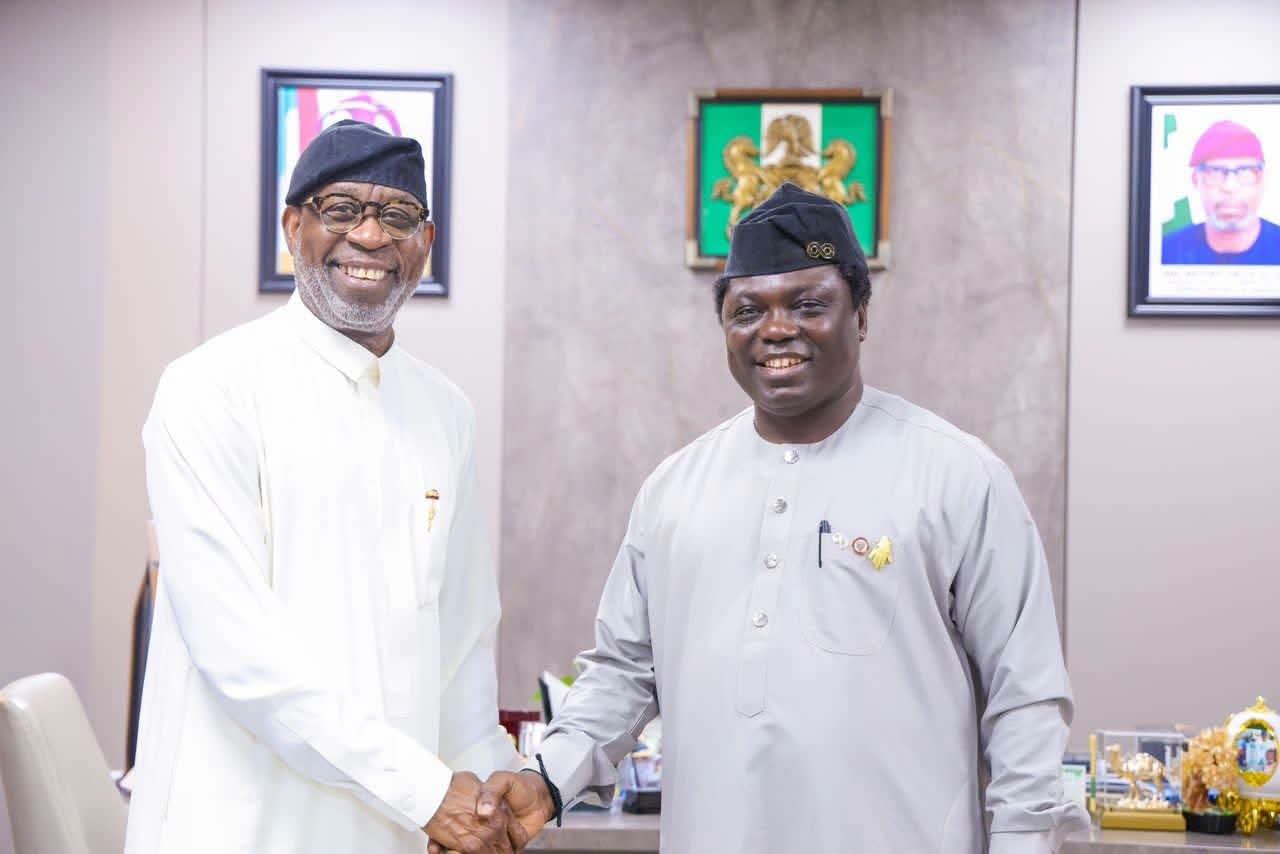
Kefas Meets Alake, Seeks Mining Opportunities for Taraba
Taraba State Governor, Dr Agbu Kefas, has opened discussions with the Federal Government on expanding mineral exploration opportunities in Taraba State while pushing for environmentally responsible mining practices that conform with global standards.
Kefas disclosed this following a visit to the Federal Ministry of Solid Minerals Development in Abuja, where he met with the Minister of Solid Minerals Development, Dele Alake.
According to the governor, discussions during the meeting focused on opportunities for mineral exploration in Taraba State and measures needed to ensure that mining operations protect the environment and comply with global best practices.
“I was at the Ministry of Solid Minerals Development in Abuja today, where I met with the Hon. Minister, Dele Alake,” Kefas stated.
He added that the discussions centred on opportunities for mineral exploration in Taraba and ways of ensuring that mining activities are conducted responsibly.
The engagement signals the Kefas administration’s interest in positioning solid minerals as another potential driver of economic development in Taraba, a state traditionally associated with agriculture, tourism and extensive natural resources.
Unlocking Taraba’s Mineral Potential
Nigeria’s renewed drive to diversify its economy beyond crude oil has placed greater attention on the solid minerals sector, creating opportunities for states with commercially viable deposits to attract exploration and investment.
For Taraba, developing the sector could provide opportunities for employment, investment, infrastructure and internally generated economic activity if supported by credible exploration, effective regulation and environmental safeguards.
Mineral exploration is particularly important because commercial mining depends on reliable information about the location, quantity and quality of deposits.
Detailed geological surveys, field investigations and geospatial technologies can help identify areas with mineral potential while providing investors and government agencies with information needed for informed decision-making.
Taraba could potentially benefit from stronger collaboration with federal authorities and relevant technical institutions in generating such information and making viable opportunities more attractive to legitimate investors.
Beyond identifying mineral resources, however, the challenge will be ensuring that exploration eventually translates into measurable benefits for communities and the state.
Kefas Emphasises Environmental Protection
A significant aspect of the governor’s meeting with Alake was the emphasis on protecting the environment.
Mining can generate employment and government revenue, but poorly managed operations can also result in deforestation, land degradation, erosion, water pollution and abandoned excavation sites.
These risks are particularly important in communities where residents depend heavily on agriculture, forests and surface or groundwater resources for their livelihoods.
Kefas’ emphasis on environmental responsibility therefore places sustainability alongside the economic opportunities associated with mining.
Environmental considerations need to begin at the exploration stage rather than after extraction has commenced.
Mining operators are expected to comply with applicable environmental requirements and adopt measures capable of reducing damage to surrounding ecosystems and communities.
Technology could also play an increasingly important role in monitoring mining activities.
Geographic Information Systems, satellite remote sensing, drones and other geospatial technologies can help authorities identify mining locations, monitor land-cover changes, measure environmental disturbances and track rehabilitation activities over time.
For a geographically large state such as Taraba, integrating these technologies into mining governance could improve monitoring and provide authorities with evidence for regulatory decisions.
Meeting Global Mining Standards
The governor also highlighted the importance of ensuring that mining operations in Taraba meet global best practices.
For investors, predictable regulation and responsible resource governance are increasingly important considerations.
Environmental protection, worker safety, transparent licensing, community engagement and responsible mine closure are among the issues that can influence the long-term sustainability of mining projects.
By prioritising these considerations early, Taraba could position itself to attract investors interested in structured mineral development rather than uncontrolled extraction.
Achieving that objective would require collaboration involving the state government, Federal Government, regulatory institutions, mining companies, traditional leaders and host communities.
Communities will be especially important because many mining projects directly affect land and natural resources on which local populations depend.
Meaningful consultation can help residents understand proposed projects and provide opportunities for concerns about land, livelihoods, compensation and environmental impacts to be addressed before operations expand.
Turning Minerals Into Jobs and Development
The broader economic opportunity for Taraba goes beyond extracting minerals.
A sustainable mining strategy could support employment in surveying, geology, engineering, environmental management, transportation, construction, data analysis, Geographic Information Systems and mineral processing.
It could also stimulate demand for accommodation, logistics, equipment maintenance and other services in communities surrounding mining operations.
However, the greatest economic benefits could emerge where mineral extraction is accompanied by local processing and value addition.
Rather than allowing mineral-bearing communities to serve only as sources of raw materials, policies that encourage processing and associated industries could potentially retain more economic value within the state.
Skills development would consequently become important.
Universities, technical institutions and research organisations could contribute by training professionals capable of supporting modern exploration and mining operations.
From Abuja Meeting to Implementation
Kefas’ meeting with Alake represents an early step towards strengthening cooperation between Taraba State and federal authorities in the solid minerals sector.
The greater test will be translating discussions into exploration programmes, investment opportunities and responsible mining projects capable of delivering measurable benefits.
Accurate geological information, transparent investment processes, strong environmental safeguards and effective monitoring will be essential.
Equally important will be ensuring that communities located around mineral deposits benefit from development rather than carrying disproportionate environmental and social costs.
Taraba has an opportunity to approach mineral development differently by combining economic ambitions with environmental responsibility from the outset.
If the discussions initiated in Abuja lead to credible exploration and responsible investment, the solid minerals sector could become another component of Taraba’s economic diversification agenda, creating opportunities alongside agriculture, tourism and other sectors.
For the Kefas administration, the task ahead will therefore extend beyond attracting mining companies. It will involve building a framework capable of turning Taraba’s mineral resources into jobs, investment and sustainable development while protecting the state’s environment for future generations.
The Abuja engagement indicates that the conversation has begun. What follows will determine how much of Taraba’s mineral potential can be responsibly converted into economic opportunities for its people.
