
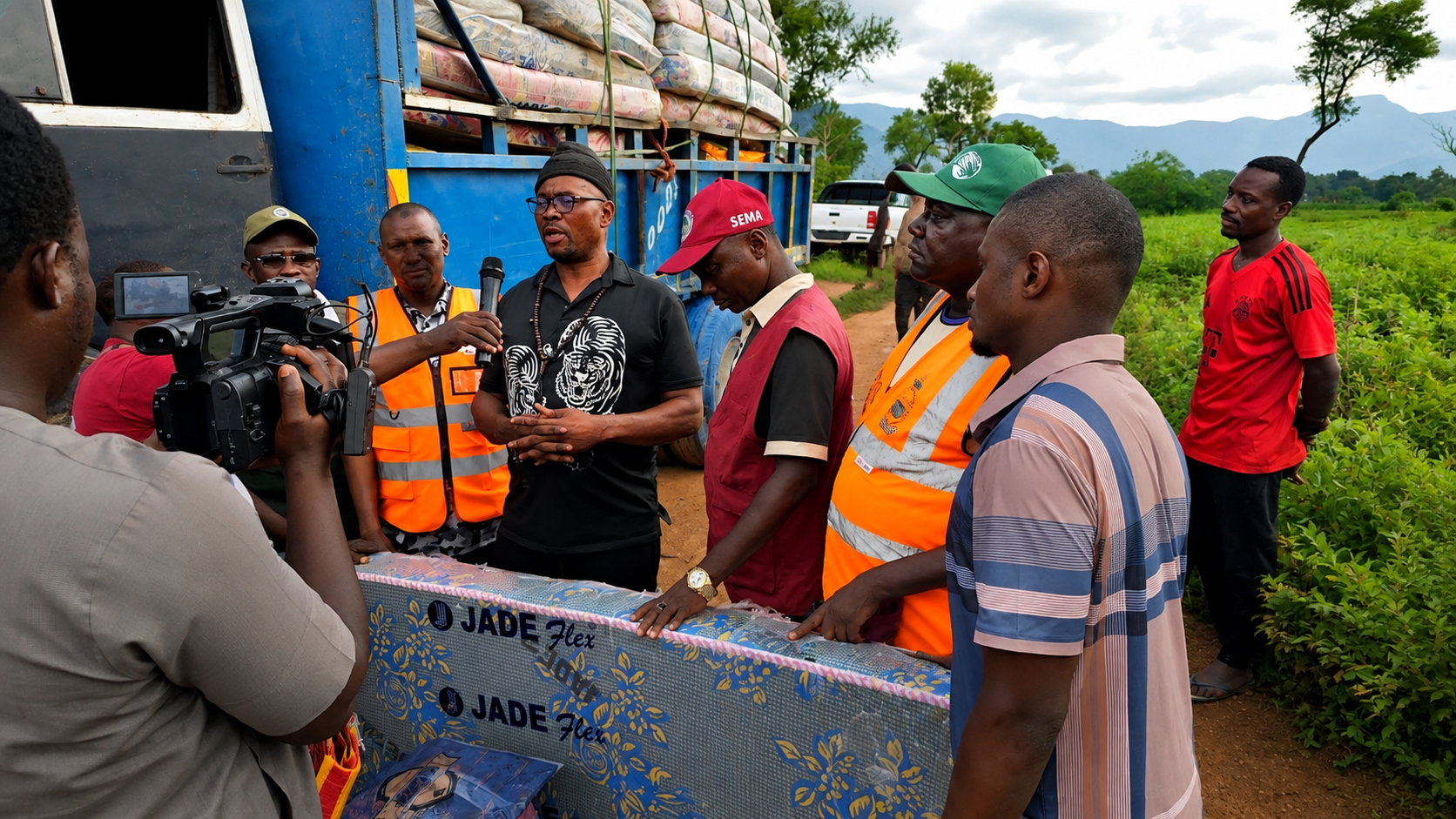
Taraba Distributes Relief Materials to Gomu Clash Victims
The Taraba State Government, through the Taraba State Emergency Management Agency (TSEMA), has distributed relief materials to victims of a communal clash in Gomu, Karim-Lamido Local Government Area of the state.
The intervention is aimed at providing immediate support to people affected by the crisis and helping vulnerable households cope with the humanitarian consequences of the communal violence.
The August 27, 2026 edition of Taraba News identifies the intervention as a state government relief operation carried out through TSEMA for victims of the communal clash in Gomu, Karim-Lamido.
The assistance comes as affected residents face the difficult task of recovering from the disruption associated with communal conflict.
For families caught in such crises, the impact can extend beyond immediate security concerns. Normal economic activities may be interrupted, access to food and basic household necessities can become difficult, while affected residents may require assistance before they are able to fully resume their livelihoods.
The government’s intervention therefore represents an emergency response intended to ease some of the immediate difficulties confronting the affected population.
TSEMA Leads Government Intervention
TSEMA serves as the state institution responsible for coordinating responses to emergencies and disasters affecting communities across Taraba.
Through the agency, the state government can provide humanitarian support when residents are affected by events such as communal conflicts, floods, fires and other emergencies.
In the case of Gomu, the agency’s involvement places the humanitarian needs of victims at the centre of the government’s immediate response.
Relief interventions are particularly important in the period following a communal crisis because affected households may experience sudden disruptions to their normal sources of food, income and other basic necessities.
Providing emergency assistance can help stabilise vulnerable families while wider efforts towards recovery and restoration of normal life continue.
The intervention also highlights the importance of having functional emergency-management institutions capable of responding when communities experience unexpected crises.
Attention on Victims’ Immediate Needs
Communal clashes can have serious consequences for residents even after violence has ended.
Families may lose access to their normal livelihoods, while farmers and traders can find it difficult to return immediately to their economic activities.
Children and other vulnerable members of affected communities can also experience significant disruption.
Relief materials cannot replace everything people may lose during a crisis, but timely humanitarian support can reduce some of the immediate pressure on affected households.
For this reason, the effectiveness of emergency assistance depends not only on making relief materials available but also on ensuring that support reaches those who genuinely need it.
Proper identification of victims and transparent distribution are therefore important to ensuring that humanitarian interventions achieve their intended purpose.
Communal Peace Remains Critical
Beyond the distribution of relief materials, the situation in Gomu reinforces the importance of preventing communal disagreements from escalating into violence.
Taraba State is home to numerous communities with longstanding social and economic relationships.
Many communities depend on one another through agriculture, markets, transportation and other activities. When disputes become violent, the consequences can therefore spread beyond the individuals directly involved.
Farmers may be unable to access their land. Traders can lose customers or become unable to move goods. Children may experience disruption to schooling, while families may be forced to temporarily abandon their normal activities.
Restoring peace is therefore essential not only for security but also for economic recovery.
Humanitarian assistance can respond to immediate needs, but sustainable recovery requires conditions that allow residents to return safely to their communities and livelihoods.
This makes dialogue, reconciliation and effective conflict prevention important alongside emergency relief.
Need for Sustainable Recovery
The distribution of relief materials should ideally form one part of a broader recovery process for affected residents.
After emergency assistance has been delivered, attention often shifts towards helping communities rebuild their livelihoods and restore social relationships.
For farming communities, recovery may require safe access to agricultural land.
For traders and small business owners, it may mean restoring normal commercial activities and transportation links.
For children and families, recovery means being able to return to school, homes and normal community life without fear of renewed violence.
The long-term objective should therefore be to create conditions where emergency relief is no longer required because peace has been restored and residents can support themselves again.
Government institutions, traditional leaders, community representatives, security agencies and residents all have roles to play in achieving that outcome.
Relief Distribution Requires Accountability
Humanitarian interventions also require transparency.
Relief materials provided for victims should reach the intended beneficiaries without diversion or discrimination.
Clear documentation of beneficiaries and proper supervision of distribution can help ensure that assistance is provided fairly.
This is especially important following communal conflicts, where perceptions of unequal treatment can create additional tension.
Emergency assistance should remain humanitarian and should be based on the needs of affected people.
Where communities include different groups affected by the same crisis, support should be delivered in a manner that promotes confidence and avoids deepening existing divisions.
TSEMA’s role therefore extends beyond moving relief materials. Effective emergency management requires coordination, assessment of needs and ensuring that interventions respond appropriately to the circumstances confronting affected residents.
Prevention Must Accompany Relief
While responding to victims is necessary, preventing future violence remains even more important.
Communal disputes can emerge from different local disagreements, and early intervention can sometimes prevent tensions from escalating.
Community leaders and relevant authorities therefore need mechanisms for identifying emerging disputes and addressing them before they result in violence.
Traditional institutions can play an important role because of their proximity to communities and their understanding of local relationships.
Security agencies are equally important in maintaining law and order, while government institutions can support dialogue and conflict-resolution initiatives.
Residents themselves also have a responsibility to reject violence and seek peaceful means of resolving disagreements.
The cost of communal conflict is ultimately borne by ordinary families whose livelihoods, homes and sense of security can be disrupted.
Focus Shifts to Peace and Rehabilitation
For the victims in Gomu, the distribution of relief materials provides immediate assistance, but the larger challenge remains recovery.
Affected families need an environment where they can safely rebuild their lives and resume economic activities.
The government will therefore be expected to complement humanitarian assistance with efforts that support lasting peace.
The intervention also serves as a reminder that emergency response should go hand in hand with measures designed to reduce the likelihood of future crises.
For communities across Taraba, peaceful coexistence remains essential to development.
Government investments in agriculture, education, healthcare, infrastructure and other sectors cannot achieve their full impact where communities are repeatedly disrupted by violence.
The TSEMA intervention in Gomu is therefore important as an immediate humanitarian response to people affected by the communal clash.
Its lasting significance, however, will depend on what follows.
Beyond relief materials, residents need security, reconciliation and the confidence to return fully to their livelihoods.
As affected families begin the process of recovery, attention should remain focused on protecting vulnerable residents, supporting peaceful coexistence and ensuring that disagreements within communities are resolved through dialogue rather than violence.
