
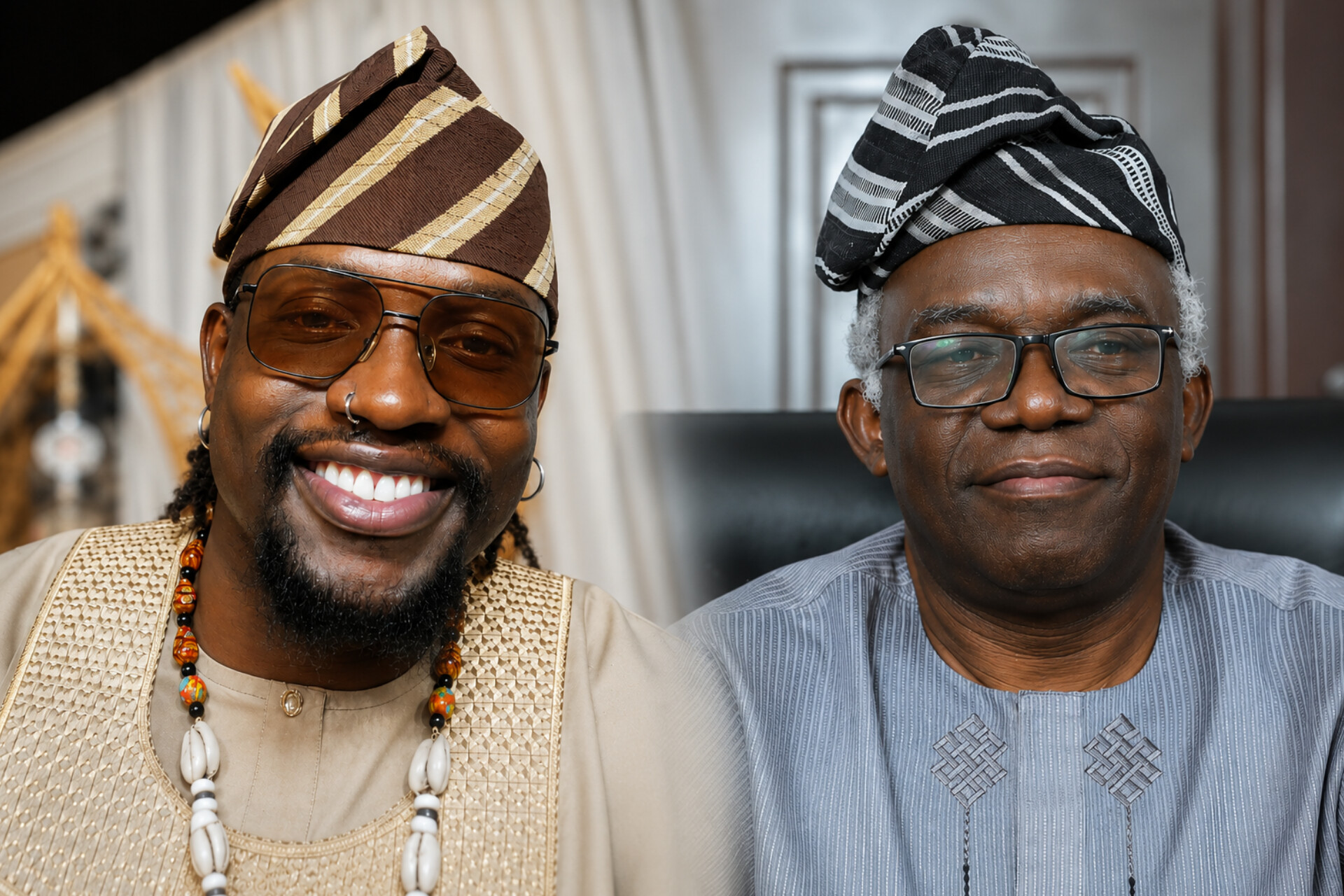
Falana Faults NBA Over VeryDarkMan’s Invitation to Security Panel
Human rights lawyer and Senior Advocate of Nigeria, Femi Falana, has criticised the Nigerian Bar Association (NBA) over its decision to invite social media commentator Martins Vincent Otse, popularly known as VeryDarkMan, as a panellist at its 66th Annual General Conference in Port Harcourt, Rivers State.
Falana questioned whether VeryDarkMan had the professional background required to participate in a high-level discussion on national security, arguing that the NBA should prioritise individuals with established expertise and experience when selecting speakers for specialised subjects.
VeryDarkMan appeared at the conference on Tuesday during a panel session titled “Known Gunmen or Unknown Gunmen,” where he spoke about insecurity in Nigeria and his experiences visiting communities affected by killings and violent attacks. His participation subsequently generated debate among lawyers and members of the public, with some questioning his suitability while others defended the NBA’s decision.
Speaking during an appearance on Channels Television’s Sunrise Daily on Thursday, Falana said NBA conferences had historically provided opportunities for lawyers to learn from people who had distinguished themselves in relevant professional fields.
According to him, the association should maintain that standard, particularly when addressing complex issues such as national security.
“In those days, the NBA brought individuals who had paid their dues, who were coming to engage lawyers intellectually,” Falana said.
He added that previous conferences were not organised as “circus shows,” insisting that speakers should bring knowledge and experience capable of enriching professional discussions.
Falana argued that a person invited to discuss Nigeria’s security challenges should ordinarily have demonstrable experience or contributions connected to the country’s security architecture, whether from the public or private sector.
He compared the situation to organising a discussion on press freedom and inviting someone without relevant experience in journalism, academia or the media industry.
For Falana, the central question was therefore not necessarily whether a social media personality could appear at an NBA event, but whether the person selected possessed experience sufficiently relevant to the particular subject under consideration.
His criticism has added another dimension to the debate surrounding VeryDarkMan’s appearance at the conference.
VeryDarkMan Defends His Invitation
VeryDarkMan had earlier responded to criticism surrounding his participation, insisting that he was not invited to teach lawyers about the law.
“There has been a lot of debate about why I was invited to this NBA conference. I’m not here to teach you people law; I’m here to share experience,” he told participants.
The activist argued that his experience visiting locations affected by violence gave him a perspective worth bringing into discussions about insecurity.
He also maintained that insecurity was not an issue confined to security professionals or government officials because ordinary citizens, including members of the legal profession, were increasingly affected by kidnapping and violent crime.
During his presentation, VeryDarkMan referred to attacks he said he had encountered or investigated and criticised what he considered inadequate attention to some violent incidents.
His appearance was eventually recognised by the NBA, which presented him with an award after his participation in the panel. The association said the recognition was in appreciation of his presence and willingness to share his experiences with participants.
Security Claims Spark Further Controversy
Beyond the debate over whether he should have been invited, some of VeryDarkMan’s statements at the conference have generated a separate controversy.
During the session, he alleged that some police officers operating checkpoints on major highways identify wealthy travellers and pass information about them to kidnappers, facilitating abductions for ransom.
The Nigeria Police Force rejected the allegation as unsubstantiated and invited VeryDarkMan to provide evidence supporting the claims.
Police authorities said allegations involving national security institutions should be supported by credible evidence, while maintaining that legitimate criticism could contribute to accountability.
VeryDarkMan subsequently said he stood by his allegations and was prepared to honour the police invitation. He indicated that he would prefer to present his evidence in court should the matter result in legal proceedings.
The development has consequently transformed what began as a debate over the selection of a conference panellist into a broader national conversation about expertise, citizen advocacy, social media influence and accountability in discussions about insecurity.
Debate Over Expertise and Lived Experience
The controversy also highlights an emerging question facing professional organisations in Nigeria: how should institutions balance traditional professional expertise with the experiences and perspectives of influential citizens outside established professional circles?
Those sympathetic to Falana’s argument may contend that professional conferences, particularly sessions dealing with sensitive subjects such as national security, require speakers whose expertise can withstand rigorous scrutiny.
From this perspective, popularity or a large social media following should not substitute for specialised knowledge and professional experience.
Supporters of VeryDarkMan’s participation, however, may argue that discussions about insecurity should not be restricted exclusively to government officials, academics and security professionals.
Citizens who visit affected communities, interact with victims and document their experiences can potentially contribute perspectives that might otherwise be absent from formal policy discussions.
VeryDarkMan himself relied substantially on this argument in explaining his participation. He presented himself not as a legal or security expert but as someone bringing firsthand observations from communities affected by insecurity.
The disagreement therefore goes beyond the personalities of Falana and VeryDarkMan. It raises a broader question about what constitutes relevant expertise in contemporary public discourse.
Professional qualifications and institutional experience remain important, particularly when technical recommendations and policies are being considered. At the same time, lived experience, field observations and citizen engagement can contribute useful information when clearly distinguished from verified expert analysis.
NBA Invitation Continues to Generate Reactions
VeryDarkMan’s appearance at the Port Harcourt conference has attracted both criticism and support within legal and public circles.
Some lawyers have questioned whether his presence was consistent with the intellectual and professional standards expected of the NBA’s flagship gathering. Others have argued that inviting unconventional voices could broaden discussions and expose professionals to perspectives outside their traditional circles.
Falana’s intervention has now placed greater attention on how the NBA selects speakers and the standards it applies when assigning individuals to specialised panels.
His comments are particularly significant because he did not merely criticise VeryDarkMan’s status as a social media figure. His argument centred on the relationship between a speaker’s experience and the subject the person had been invited to discuss.
For VeryDarkMan, however, the experiences he said he had gathered while visiting communities affected by violence provided sufficient grounds for him to contribute to the conversation.
The contrasting positions have left Nigerians debating two competing but potentially complementary ideas: the importance of professional expertise and the value of firsthand citizen experience.
What remains clear is that VeryDarkMan’s appearance at the NBA conference succeeded in generating a national conversation extending far beyond the conference hall about insecurity, accountability, professional standards and who should have a voice when Nigeria’s most pressing challenges are being discussed.
