
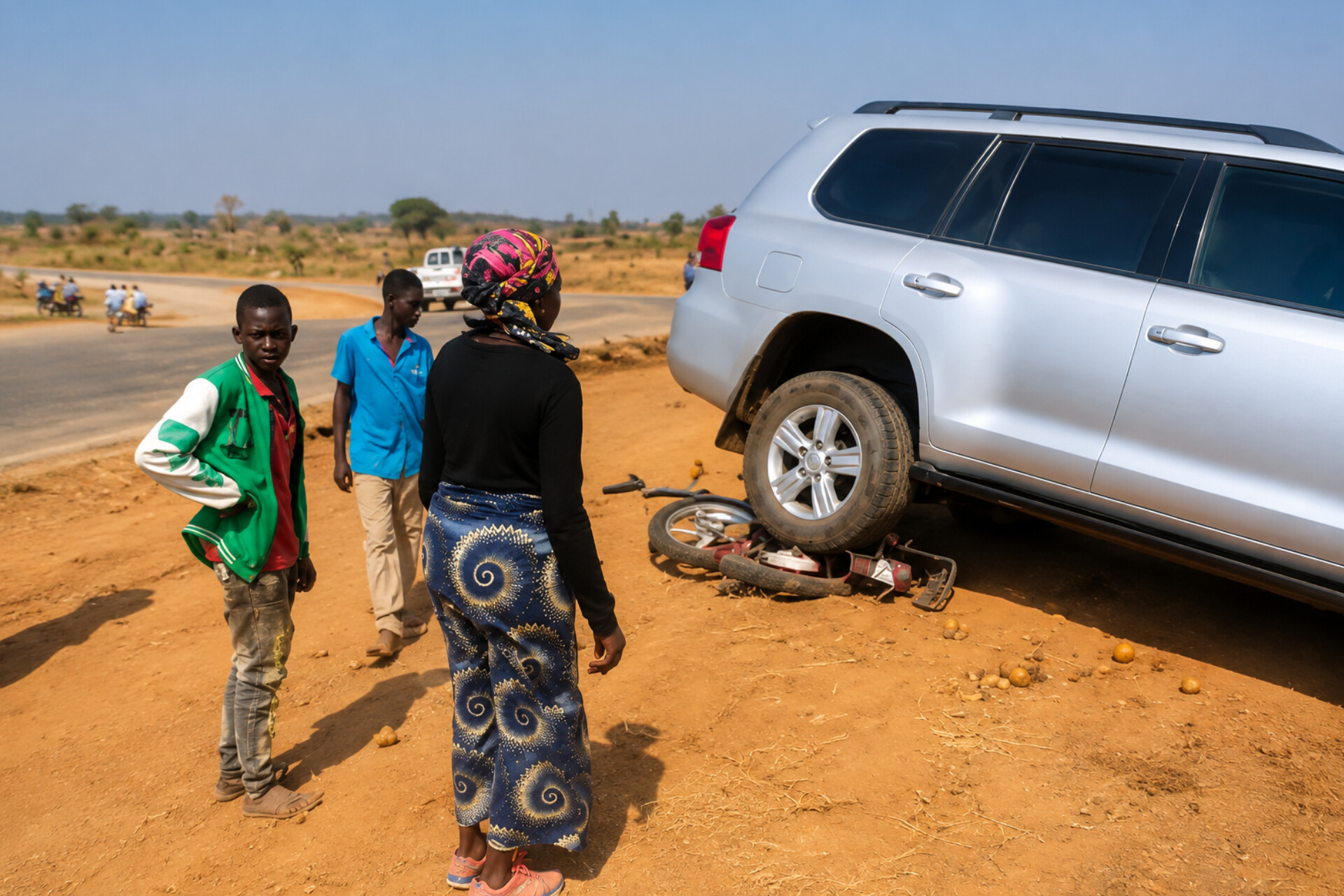
Two Killed in Sangere–FUTY Road Crash
Two people have died following a road accident involving a commercial tricycle and a sport utility vehicle along the busy Sangere–FUTY Road in Adamawa State.
The deceased were identified as the commercial tricycle operator, popularly known as Abba, and a passenger, Shamsuya Musa. The collision occurred on the road connecting communities around Sangere and Girei with Yola, the Adamawa State capital.
The spokesperson for the Adamawa State Police Command, SP Suleiman Nguroje, confirmed the deaths and disclosed that the Motor Traffic Division had commenced an investigation into the accident.
The investigation is expected to determine how the collision occurred and whether speeding, dangerous driving, mechanical failure, poor visibility or another factor contributed to the crash. Until the inquiry is concluded, responsibility for the accident has not been established.
Residents and road users who learned about the tragedy expressed sympathy with the families of the victims. The incident has also renewed concerns about safety along the Sangere–FUTY corridor, which carries a large volume of private and commercial traffic daily.
The road serves residents of surrounding communities, students and workers of Modibbo Adama University, Yola, formerly known as the Federal University of Technology, Yola. Despite the institution’s name change, many residents still refer to the route as Sangere–FUTY Road.
Commercial tricycles, popularly called Keke Napep, are among the most widely used means of transportation along the corridor. They provide relatively affordable transport for students, traders, civil servants and other commuters travelling between Yola, Sangere, Girei and neighbouring settlements.
However, the growing number of vehicles operating on the road has increased pressure on the corridor, particularly during morning and evening periods when students and workers are travelling to or returning from their destinations.
Another fatal incident on a busy corridor
The latest accident occurred less than two weeks after a final-year student of Modibbo Adama University reportedly died in another road accident around the Sangere–FUTY area.
The student, identified as Isabella Hassan, was reportedly travelling along the university road when she was involved in an accident with a moving truck. Her death threw her family, friends and members of the university community into mourning.
Although the circumstances surrounding the two accidents are different and investigations must be treated separately, their occurrence within the same month has intensified calls for closer attention to road safety along the corridor.
Residents have repeatedly expressed concern about speeding, risky overtaking, indiscriminate stopping by commercial vehicles and competition among drivers for passengers. These concerns have not been officially established as the cause of the latest crash, but they point to issues that traffic authorities may need to examine.
The movement of heavy-duty vehicles, private cars, motorcycles, tricycles and pedestrians on the same road also creates safety challenges. Students and residents regularly cross sections of the road to reach schools, shops, residential areas and public transport points.
Where designated pedestrian crossings, road signs, streetlights and speed-control measures are inadequate, the risk of accidents can increase, particularly at night or during periods of poor visibility.
Commercial tricycles remain important to Adamawa’s transportation system, but their small size makes occupants especially vulnerable during collisions with larger vehicles. Unlike passengers in conventional cars, tricycle occupants have limited protection from the direct impact of a crash.
This vulnerability places greater responsibility on both tricycle operators and drivers of larger vehicles to obey speed limits, maintain safe distances and avoid dangerous manoeuvres.
Police investigation must establish the facts
The Adamawa State Police Command’s Motor Traffic Division is expected to examine the vehicles involved, interview witnesses and review available information from the accident scene.
Such an investigation is important not only for determining responsibility but also for identifying measures that could prevent similar incidents. Findings from fatal accidents can reveal recurring problems involving road design, driver behaviour, vehicle condition or traffic enforcement.
Authorities have not publicly announced the result of the investigation or disclosed whether any person has been taken into custody in connection with the crash.
It would therefore be inappropriate to blame either driver before the police complete their inquiry. Witness accounts, photographs or claims circulated on social media should also be treated cautiously unless verified by the relevant authorities.
Families affected by fatal road accidents deserve accurate information about what happened. A thorough investigation can help answer their questions while ensuring that anyone found to have violated traffic regulations is treated according to the law.
The findings could also guide the Federal Road Safety Corps, police traffic officers, local authorities and other relevant institutions in strengthening safety measures along the route.
Calls for stronger traffic management
The Sangere–FUTY Road requires coordinated traffic management because of its importance to surrounding communities and the university population. Measures such as visible road signs, functional streetlights, speed limits and designated passenger-loading points could improve safety.
Regular patrols during peak periods could help discourage reckless driving and prevent commercial vehicles from stopping abruptly or blocking sections of the road while searching for passengers.
Authorities could also assess areas where students and residents frequently cross the road and consider installing pedestrian crossings, warning signs or speed-calming infrastructure.
Commercial transport unions have an equally important role to play. They can organise regular safety education for members, discourage drivers from operating under the influence of alcohol or drugs and sanction those who repeatedly violate traffic rules.
Vehicle owners should ensure that tricycles, cars and other commercial vehicles are properly maintained. Faulty brakes, worn tyres, defective lights and poor steering systems can turn an avoidable situation into a fatal accident.
Passengers can contribute by refusing to encourage speeding and reporting drivers whose conduct puts lives at risk. Road safety should be treated as a shared responsibility involving motorists, passengers, pedestrians, transport unions and government agencies.
The Federal Road Safety Corps has consistently advised drivers to avoid speeding, wrongful overtaking, overloading and distracted driving. These precautions are particularly important during the rainy season, when wet roads can reduce tyre grip and increase the distance required for vehicles to stop.
Families left in mourning
Beyond the damaged vehicles and traffic disruption, the accident has left two families grieving. Abba and Shamsuya Musa began their journey as part of an ordinary day but did not return home.
Their deaths demonstrate the human cost of road crashes and the need for sustained action to protect commuters. Every fatality represents a family member, friend, colleague or breadwinner whose absence can create lasting emotional and economic hardship.
As the police investigation continues, residents will expect a clear account of what caused the collision and whether any preventive steps will be introduced along the Sangere–FUTY corridor.
Improved enforcement, safer driving and appropriate road infrastructure could help prevent another family from experiencing a similar loss. For now, the community mourns the two victims while awaiting the outcome of the official investigation.
