
Taraba Returns Over 100 Seized Mining Machines
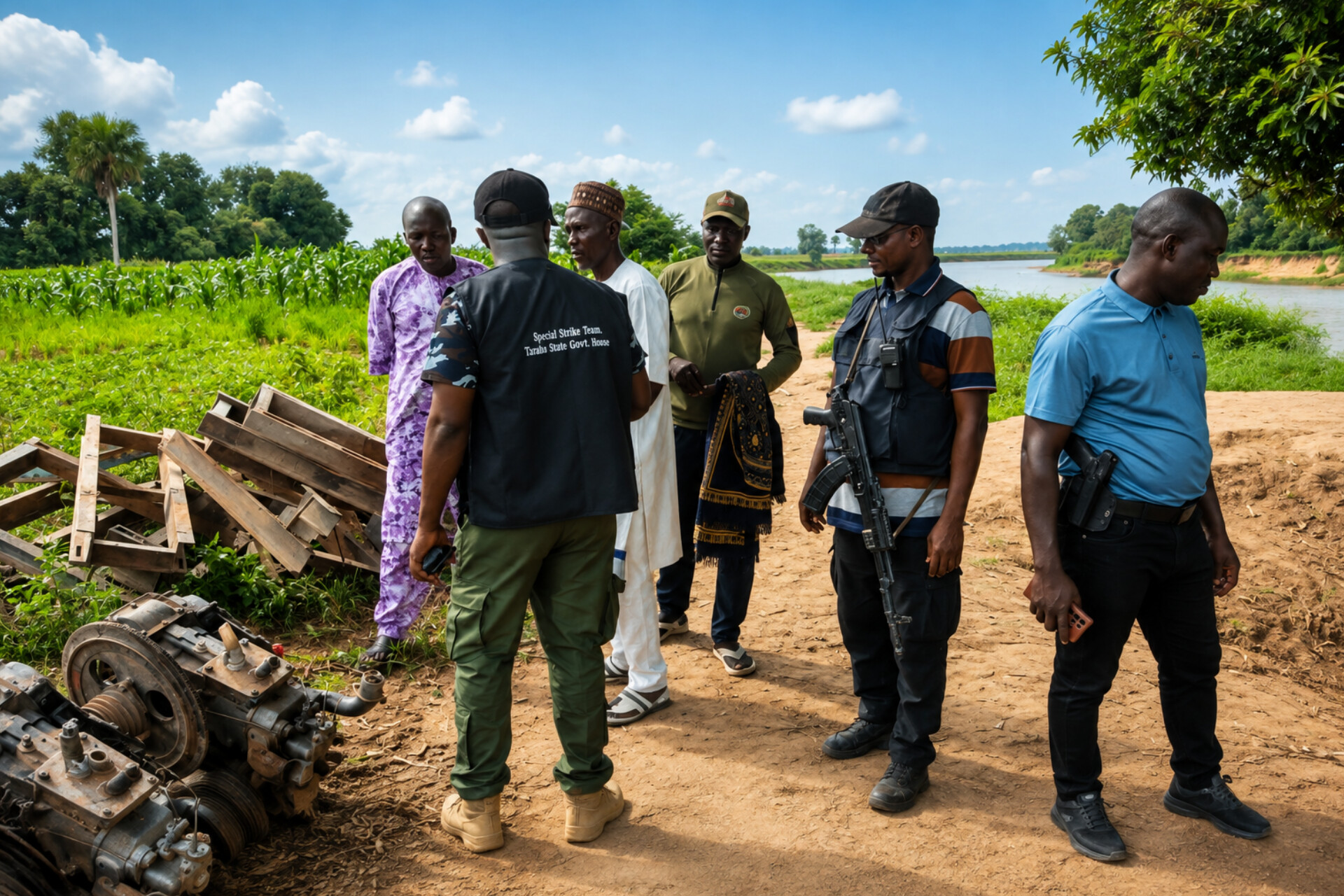
The Taraba State Government has begun returning more than 100 pieces of mining equipment previously seized during enforcement operations against illegal mining activities, following a review that cleared affected operators for the release of their machines.
The exercise, carried out at Mayo Kam, represents an important development in the state’s ongoing attempt to regulate mining activities while distinguishing operators considered eligible to resume legitimate operations from those acting outside established requirements.
According to the report, the equipment had been confiscated by the Taraba State Special Taskforce on Environmental Protection, Public Safety and Deforestation Prohibition during operations targeting unauthorised mining activities. The items included excavators and other heavy machinery used at mining sites.
The decision to return the machines comes against the wider challenge of ensuring that Taraba’s mineral resources contribute to economic development without encouraging environmental degradation, unregulated extraction or activities that leave host communities with long-term consequences.
Taraba is endowed with mineral resources capable of supporting investment, employment and internally generated revenue. But the economic potential of mining can only be realised sustainably when extraction takes place within a regulatory system that protects communities and the environment.
From Enforcement to Compliance
Seizing heavy equipment is one of the strongest tools available to authorities attempting to stop unauthorised mining.
Mining operations depend heavily on machinery. Removing excavators and related equipment can immediately disrupt activities at a site and compel operators to engage regulators.
However, enforcement should not end with seizure.
Authorities also need a transparent process for determining why equipment was confiscated, what an operator must do to achieve compliance and under what conditions seized property can be released.
The return of more than 100 machines therefore raises an important issue about the relationship between enforcement and regulatory compliance.
Where operators have satisfied relevant requirements, the objective of regulation should ideally be to bring lawful economic activity under proper supervision rather than permanently prevent legitimate businesses from operating.
At the same time, returning equipment should not be interpreted as permission for mining without restrictions.
Operators remain responsible for complying with applicable laws and environmental requirements.
Illegal Mining Has Wider Consequences
Unregulated mining is not merely a question of whether an operator possesses the correct documents.
Poorly controlled extraction can damage farmland, pollute water sources, destroy vegetation and create dangerous abandoned pits.
The consequences can remain long after miners leave a location.
For rural communities whose livelihoods depend on farming, grazing and local water resources, environmental damage from mining can directly threaten household income and food security.
That is why regulatory agencies need to monitor what happens after mining equipment is returned.
Compliance cannot be established once and then forgotten.
Regular inspection of mining sites can help determine whether operators are respecting approved boundaries, environmental obligations and safety standards.
Communities Must Benefit
Another important question is how communities located around mineral deposits benefit from mining activities.
Natural resources can generate considerable commercial value, but host communities sometimes experience environmental damage without seeing corresponding improvements in employment, infrastructure or economic opportunity.
Responsible mining should therefore include meaningful engagement with affected communities.
Where legally applicable, operators should comply with environmental restoration obligations and other responsibilities associated with their activities.
Community concerns should also be taken seriously before they develop into disputes.
Mining companies can strengthen relationships by employing qualified local workers where possible, supporting legitimate community-development arrangements and maintaining communication with traditional and community leadership.
However, community benefit should not become an excuse for informal payments or arrangements that undermine established regulatory procedures.
The goal should be a transparent system in which government, operators and communities understand their respective responsibilities.
Government Needs a Clear Mining Strategy
Taraba’s approach to mining should ultimately extend beyond periodic enforcement operations.
The state needs a broader strategy for ensuring that mineral resources support long-term economic development.
Such a strategy should include reliable information about mineral locations, environmental sensitivity, existing operators and affected communities.
Technology can help.
Geographic information systems, satellite imagery and remote-sensing techniques can support the monitoring of mining sites and changes in land cover.
Authorities can use spatial information to identify expansion outside authorised locations, monitor environmental disturbance and prioritise areas requiring field inspection.
This is particularly valuable where mining takes place in remote areas that cannot be inspected continuously.
Regulation Must Be Predictable
Investors also need regulatory certainty.
A responsible operator should be able to understand what is required to conduct business legally and what consequences follow non-compliance.
Rules that are unclear or applied inconsistently can discourage legitimate investment while creating opportunities for informal practices.
At the same time, operators should understand that environmental protection is not an optional cost.
Mining physically alters landscapes. Responsible companies must therefore plan for environmental management from the beginning rather than waiting until extraction has ended.
Where rehabilitation is required, affected land should be restored in accordance with applicable standards.
Returned Machines Should Mark a New Phase
For the operators receiving their equipment, the release represents an opportunity to demonstrate compliance.
For the state government, it creates an equally important responsibility to ensure that the same machines are not subsequently used in activities that violate regulations.
The success of the exercise will therefore not be measured simply by how many excavators are returned.
It will be measured by what happens at mining sites afterwards.
If the equipment returns to properly regulated operations, jobs and economic activities can resume while government strengthens oversight.
If illegal operations simply restart, the original enforcement effort would have achieved little.
Balancing Investment and Environmental Protection
Taraba does not have to choose between mining and environmental protection.
Proper regulation should make it possible to pursue both.
Mineral resources can support employment, business activity and public revenue. But those benefits become less meaningful if mining destroys agricultural land, contaminates water or creates unsafe environments for surrounding communities.
The return of more than 100 seized machines therefore represents more than an administrative exercise.
It is a test of whether enforcement can produce lasting compliance.
The next phase should focus on monitoring, transparency and responsible extraction.
Taraba’s mineral wealth can become an important component of its economic future, but only if the state ensures that the resources are exploited legally, communities are protected and environmental consequences are properly managed.
