
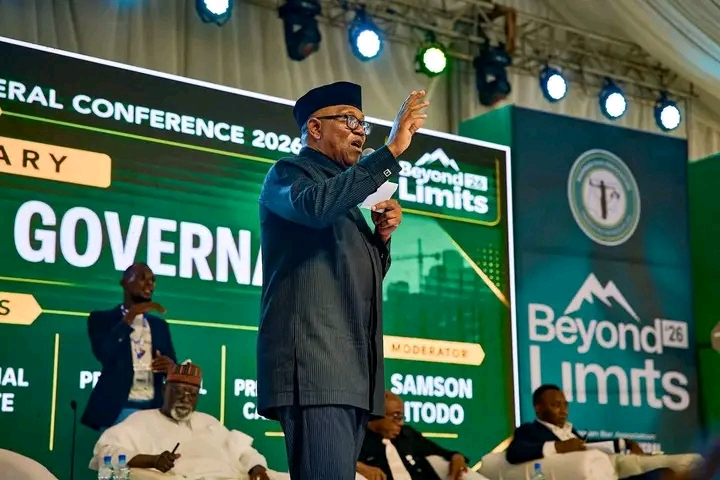
Nigeria has the resources, people and potential needed to become a prosperous nation, but achieving that future will require competent, honest and purposeful leadership, according to former presidential candidate Peter Obi.
Obi made the remarks while speaking as a guest and panellist alongside some presidential candidates and their representatives at the 66th Annual General Conference of the Nigerian Bar Association, held at the Yakubu Gowon Stadium in Port Harcourt, Rivers State.
The discussion focused on practical ways to rebuild Nigeria and create a country that works for its resilient, hardworking and long-suffering citizens.
During the engagement, Obi reiterated his long-standing position that the poverty and hunger experienced by many Nigerians are largely connected to years of mismanagement and corruption by leaders entrusted with the country’s commonwealth.
He argued that Nigeria’s vast human and natural resources make the country’s continued struggle with extreme poverty and hunger unacceptable.
According to him, Nigeria also has little justification for importing food on a large scale when the country possesses enormous agricultural potential that, if properly developed, could transform the economy.
Obi particularly highlighted the agricultural opportunities available in Northern Nigeria, where vast areas of farmland could support increased food production, create employment and generate wealth.
He maintained that with the right investments, sound policies and political will, agriculture could become one of Nigeria’s greatest sources of economic growth.
He pointed to countries with fewer resources that have successfully transformed their agricultural sectors, arguing that Nigeria can similarly build a productive agricultural economy capable of feeding its population while creating millions of jobs and producing food for export.
On the controversial issue of fuel subsidy removal, Obi restated the position he took during the 2023 presidential election campaign.
He said the subsidy system was riddled with corruption and maintained that his preferred approach would have been to first eliminate the corruption within the system, establish the actual cost of the subsidy and then implement a carefully planned and phased removal.
Obi also stressed the importance of transparency in the use of savings generated from subsidy reforms.
According to him, such savings should have been directed into clearly defined and measurable development priorities, particularly agriculture, healthcare, education, poverty reduction and national security.
He argued that Nigerians should be able to see tangible benefits from major economic reforms. In his view, citizens should not continue to face higher energy costs while the savings from subsidy removal remain unaccounted for or fail to translate into meaningful improvements in their standard of living.
The former Anambra State governor said Nigeria’s investment priorities should remain focused on areas capable of improving the lives of citizens and strengthening the country’s future.
These areas, he noted, include food security, healthcare, education, infrastructure, human capital development, national security and national unity.
His comments come amid continuing public concerns over the cost of living, food prices, energy costs, unemployment and the broader economic challenges facing households and businesses across the country.
Obi’s central message was that Nigeria’s difficulties are not necessarily caused by a lack of resources. Rather, he argued, the country’s major challenge is how its resources are managed and whether leadership decisions are directed toward the common good.
He therefore called for leadership that prioritises accountability, competence and national interest over personal or political interests.
“Nigeria has all it needs to prosper,” Obi said, stressing that what is required is leadership capable of turning the country’s enormous potential into measurable improvements in the lives of its citizens.
He concluded with an optimistic message about the country’s future, declaring that a New Nigeria is possible and expressing confidence that Nigeria will be okay.
He urged leaders and citizens to stay committed to building a stronger nation.
