
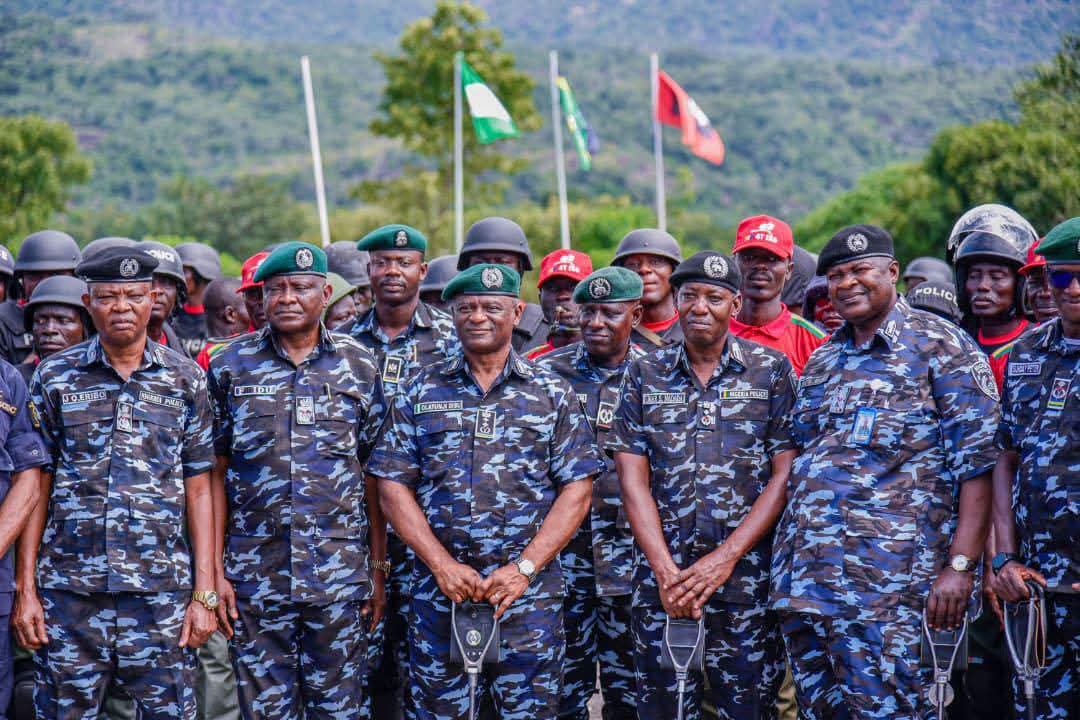
IGP Disu Moves to Strengthen PMF, Orders Trainers to Raise Combat Readiness
Inspector-General of Police, IGP Olatunji Rilwan Disu, has moved to strengthen the operational capacity of the Police Mobile Force, directing trainers and instructors to prioritise tactical competence, discipline and continuous combat readiness across the Force’s 84 PMF squadrons.
Disu gave the directive on Friday, August 28, 2026, while declaring open the Training Course for Trainers and Instructors at the Police Mobile Force Training College, Ende-Hills, Nasarawa State.
The programme brings together selected PMF trainers and instructors from formations across Nigeria as part of efforts to sharpen tactical skills, improve instructional standards and strengthen the preparedness of personnel deployed for critical security operations.
The IGP described the training as a strategic investment in the future of the Police Mobile Force, stressing that Nigeria’s evolving security challenges require tactical personnel who can rapidly adapt to new threats while maintaining professionalism and respect for the law.
He charged participants to return to their formations as “force multipliers,” ensuring that knowledge and operational techniques acquired during the course are transferred to other personnel.
For Disu, the objective goes beyond training a limited number of instructors. The wider goal is to use those instructors to raise operational standards across PMF squadrons nationwide.
IGP Demands Competence, Not Certificates
Disu warned participants against treating the course as another opportunity to obtain certificates without corresponding improvements in their capabilities.
He stressed that the true measure of the programme would be seen in how personnel perform during real operations.
According to the IGP, operational readiness must become a permanent culture within the Police Mobile Force rather than something activated only when security emergencies arise.
The modern PMF officer, he said, must combine tactical strength with intelligence, precision, discipline, professionalism and respect for established laws and operational procedures.
The message places greater responsibility on instructors, who are expected to shape not only the tactical abilities of personnel but also their judgement and conduct during deployments.
As one of the major tactical components of the Nigeria Police Force, the PMF is frequently expected to provide reinforcement and specialised operational support during serious security situations.
Maintaining that capability requires personnel who can respond quickly and decisively while remaining disciplined under pressure.
Training Targets All 84 PMF Squadrons
The significance of the Ende-Hills programme extends beyond the personnel attending the course.
Participants were selected from different parts of the country and are expected to take their newly acquired knowledge back to their respective formations.
That training-the-trainer approach could enable the Force to spread improved tactical standards across its 84 PMF squadrons without limiting the benefits to personnel physically attending the programme.
It also places instructors at the centre of the Force’s effort to improve preparedness.
A poorly trained instructor can reproduce weaknesses across several batches of personnel. Conversely, a highly competent instructor can influence hundreds of officers over time, making investment in trainers a potentially significant part of institutional reform.
The IGP therefore urged participants to recognise the wider responsibility attached to their selection for the programme.
Senior Security Chiefs Attend
The opening ceremony attracted senior officers and security officials.
Among those present were DIG Umar Shehu Nadada, Deputy Inspector-General of Police in charge of Operations; AIG Alonyenu Idu, Assistant Inspector-General of Police overseeing the Police Mobile Force; and DCP Sunday Audu Peter, Commandant of the PMF Training College, Ende-Hills.
The Nasarawa State Commandant of the Nigeria Security and Civil Defence Corps, Brah Samson Umoru, was also present alongside commandants of other PMF training colleges.
Nasarawa State Governor, Abdullahi A. Sule, briefly attended the ceremony and congratulated the IGP on his leadership and efforts towards strengthening the Nigeria Police Force.
AIG Alonyenu Idu, speaking at the event, commended the police leadership for its commitment to repositioning the PMF.
He challenged personnel to protect the operational reputation of the Mobile Police as a major tactical strike arm of the Nigeria Police Force.
Tactical Displays Put Skills to the Test
The ceremony was not restricted to speeches.
Personnel undergoing the training carried out tactical displays and practical demonstrations designed to showcase their operational skills, coordination and discipline.
The exercises highlighted the practical focus of the programme and the importance of ensuring that personnel can apply what they learn under conditions similar to those encountered during deployments.
For tactical formations, classroom knowledge alone is insufficient. Personnel may be required to make rapid decisions in dangerous and unpredictable situations where mistakes can have serious consequences.
Regular practical training can therefore help improve coordination, judgement and response under pressure.
Police Push Professionalism Alongside Firepower
A major element of Disu’s message was that tactical capability must not be separated from professionalism.
While PMF personnel require the ability to respond decisively to serious threats, the IGP stressed that their operations must remain guided by intelligence, precision, discipline and respect for the law.
That balance will be crucial as the Force seeks to strengthen public confidence while improving its response to security challenges.
The effectiveness of a tactical police unit is not determined solely by weapons, equipment or physical strength. Intelligence gathering, decision-making, coordination, discipline and adherence to lawful procedures can be equally decisive during operations.
The Force said it remains committed to continuous professional training, modernisation and personnel welfare, alongside providing the equipment and platforms required to improve operational effectiveness.
The ultimate test of the Ende-Hills training, however, will come after the participants return to their formations.
If the knowledge acquired is successfully transferred to other personnel, the programme could have an impact far beyond the training college, strengthening preparedness across PMF squadrons nationwide.
Disu has consequently placed trainers at the heart of that effort.
His directive leaves them with a clear assignment: build personnel who are not merely trained to respond to threats, but are prepared to operate with speed, intelligence, precision, discipline and professionalism whenever duty calls.
For the Police Mobile Force, the message from Ende-Hills is equally clear readiness must become a culture, not an emergency response.
