
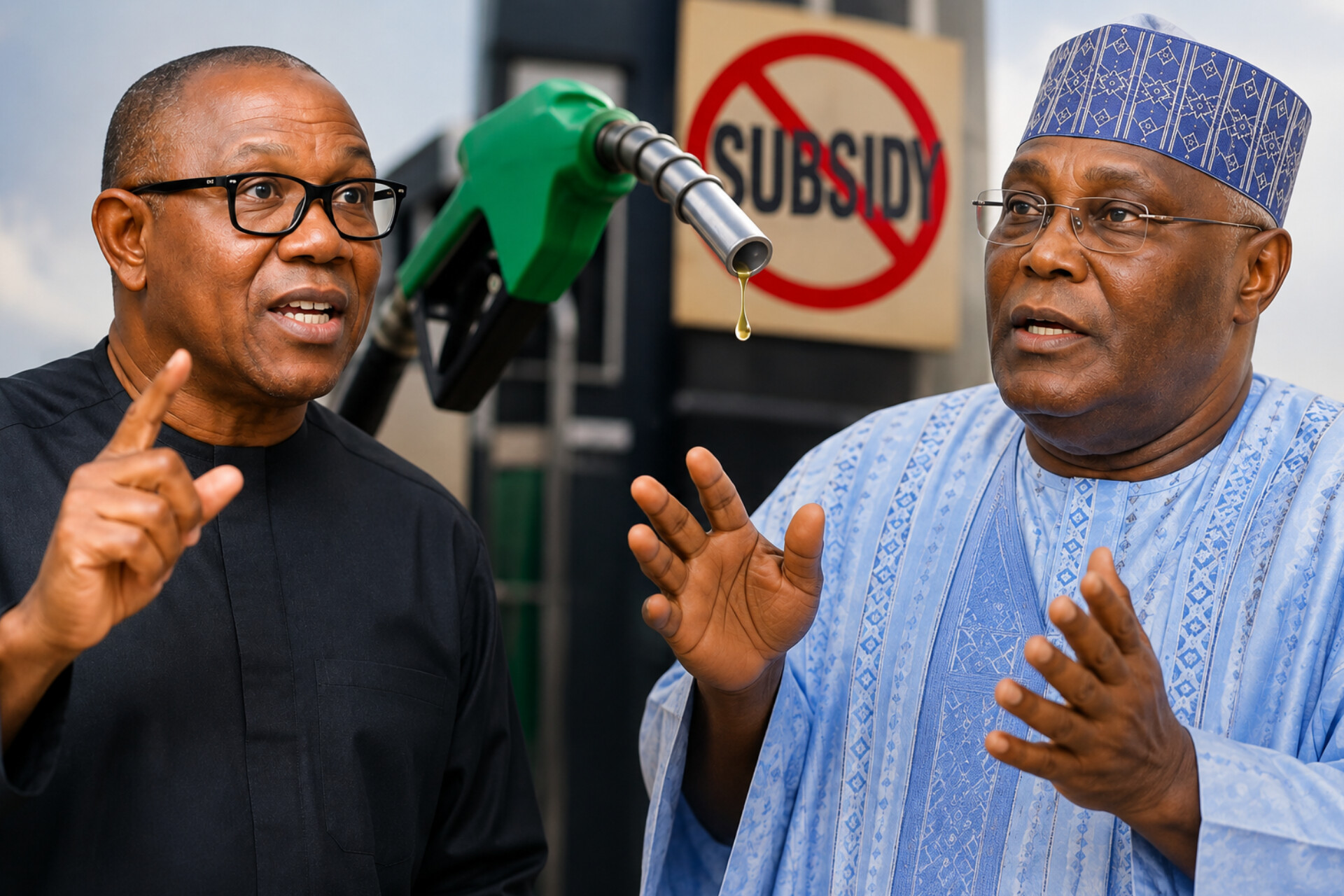
Peter Obi has rejected Atiku Abubakar’s proposal to restore fuel subsidy if elected in 2027, arguing that subsidy removal is necessary but its proceeds must be properly managed and invested.
Peter Obi has rejected Atiku Abubakar’s proposal to restore fuel subsidy if elected in 2027, arguing that subsidy removal is necessary but its proceeds must be properly managed and invested.
Presidential candidate of the Nigerian Democratic Congress (NDC), Peter Obi, has disagreed with former Vice President Atiku Abubakar over the future of fuel subsidy in Nigeria, insisting that the removal of the subsidy should not be reversed.
Obi made his position known on Monday, August 24, 2026, during the Nigerian Bar Association’s 66th Annual General Conference in Port Harcourt, Rivers State, where several presidential hopefuls discussed major national issues ahead of the 2027 general elections.
The former Anambra State governor was responding to Atiku’s recent proposal to restore fuel subsidy if elected president in 2027.
Obi: Subsidy Removal Was Necessary
Obi maintained that he supported the removal of the subsidy but criticised the way the government handled the proceeds generated from the policy.
According to him, the problem was not necessarily the removal of the subsidy but the failure to properly manage and invest the money saved from it.
“I subscribe and I maintain that we need to remove subsidy. Mismanagement of the proceeds should not be the reason for not removing it,” Obi said.
He argued that Nigerians should have been provided with meaningful alternatives to reduce the impact of higher petrol prices following the removal of the subsidy.
Focus Should Be on Subsidy Savings
Obi said the resources recovered from subsidy removal should have been invested in sectors that directly improve the lives of Nigerians.
He argued that the government could have used the savings to strengthen critical areas such as healthcare, education, infrastructure, transportation and other productive sectors.
According to him, proper investment of the funds could have helped reduce the hardship experienced by citizens while also supporting economic growth.
The NDC presidential candidate stressed that his position on subsidy removal was not new, pointing to his 2023 presidential manifesto as evidence that he had previously advocated an organised approach to removing the policy.
“Go to my manifesto, I said it before, I said I will do it in an organised manner and whatever we recover would be invested appropriately,” Obi said.
Atiku Wants Subsidy Restored
Atiku, meanwhile, has taken a different position on the issue.
The former vice president has argued that the removal of fuel subsidy has contributed to the economic difficulties facing Nigerians and has proposed restoring the policy if he wins the 2027 presidential election.
The debate has become increasingly important as political parties and presidential candidates begin presenting their economic programmes to Nigerians ahead of the election.
While Atiku believes restoring subsidy could help ease the burden on citizens, Obi maintains that returning to the old system would not address the fundamental problems affecting Nigeria’s economy.
Fuel Subsidy Remains a Major Political Issue
President Bola Ahmed Tinubu announced the removal of petrol subsidy on May 29, 2023, shortly after assuming office.
The policy resulted in a sharp increase in petrol prices and contributed to higher transportation costs and rising prices of goods and services across the country.
The Federal Government has defended the decision as necessary to reduce the financial burden of subsidy on government finances and redirect resources towards development.
However, many Nigerians have continued to express concerns over the effect of the policy on household incomes and the general cost of living.
The controversy surrounding subsidy removal has consequently become one of the major economic issues expected to shape the 2027 presidential election.
Obi Calls for Accountability
Obi’s argument centres on accountability and the effective use of public resources.
Rather than returning to the previous subsidy arrangement, he wants the government to ensure that resources saved from subsidy removal are properly accounted for and invested in projects capable of producing measurable benefits for citizens.
He has repeatedly advocated for greater investment in productive sectors of the economy, arguing that government resources should be used to create jobs, improve human development and increase national productivity.
Different Views Among Opposition Candidates
The disagreement between Obi and Atiku highlights the different economic approaches being presented by opposition politicians ahead of the 2027 election.
Other presidential hopefuls have also expressed varying positions on subsidy, insecurity, policing, taxation and economic management.
For Nigerian voters, the debate is likely to remain focused on a key question: whether subsidy should be restored or whether the government should maintain its removal while ensuring that the resulting savings are properly managed.
As the 2027 election draws closer, Obi’s latest comments demonstrate that the opposition is not united on the future of fuel subsidy.
While Atiku is advocating for a return to subsidy as a possible measure to ease economic hardship, Obi believes the better solution is to maintain its removal and ensure that the resources saved are transparently and productively invested.
The contrasting positions are expected to fuel further public debate as Nigerians assess the economic policies and promises of presidential candidates ahead of the 2027 general election
