
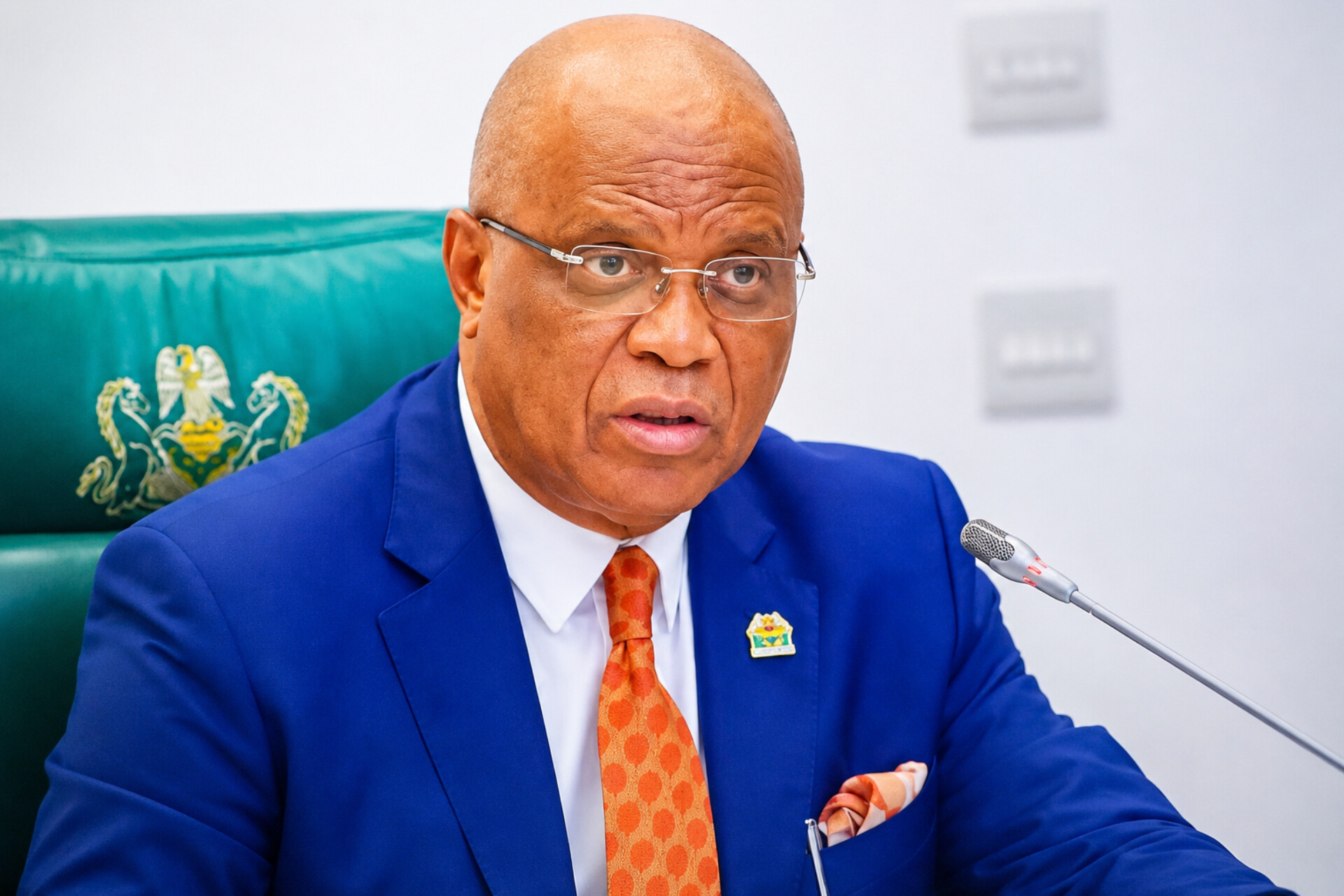
Umo Eno: I Made at Least ₦10m Monthly Selling Akara, Bread
Akwa Ibom State Governor, Pastor Umo Eno, has stirred widespread conversation after revealing that a business he built around akara, bread and coffee once generated not less than ₦10 million in a month.
The governor shared the story while recounting his journey as an entrepreneur before his rise to political leadership, presenting his experience as an example of how seemingly small businesses can grow when approached with innovation and determination.
Speaking at the September edition of the state’s monthly gathering, Eno recalled that he started by selling akara, the popular Nigerian bean cake, alongside bread.
But instead of treating them merely as separate food items, the businessman introduced what he described as an “akara burger” — opening a loaf of bread and putting akara inside it for customers.
“We still have that shop there. I started selling akara and bread. We’re doing akara burger. We’d open the bread and put akara for you,” Eno said.
The governor explained that the business benefited from customers heading to work, including people working at ExxonMobil, who would stop in the morning to buy food and coffee.
As demand increased, according to his account, the operation expanded into a coffee shop.
“People going to work in ExxonMobil would buy it in the morning, take coffee. We started coffee shop,” he said.
Then came the statement that immediately attracted attention.
“Every month, that akara and bread business used to give me nothing less than N10 million,” Eno said.
His remarks have since generated debate, particularly over the scale of the figure attached to a business that started with one of Nigeria’s most familiar street foods.
From Akara to Hospitality Business
While the ₦10 million figure has attracted the headlines, Eno’s documented business history stretches well beyond selling akara and bread.
According to his official profile published by the Akwa Ibom State Government, Eno established Royalty Hotels & Recreations Ltd in 1997, beginning with only five rooms.
The business subsequently expanded into a wider hospitality group covering hotels, apartments, eateries, coffee shops, industrial catering and packaged water.
His official biography also describes him as an established player in industrial catering, particularly within the oil and gas sector.
The background provides important context to his latest remarks. Eno’s entrepreneurial story was not limited to a roadside akara operation but developed into a broader hospitality and catering enterprise over time.
Before establishing his own hospitality business, Eno also worked in the banking and private sectors, including positions at Union Bank, Bertola Machine Tools Ltd and Norman Holdings Ltd.
He later entered public service before eventually becoming governor of Akwa Ibom State.
₦10m Claim Sparks Questions
Despite Eno’s established history as an entrepreneur, his statement that the akara and bread business generated at least ₦10 million monthly has triggered scepticism and questions about what exactly the figure represents.
One of the major questions is whether the governor was referring to monthly turnover, gross revenue or net profit.
Those figures can tell very different stories.
A business recording ₦10 million in monthly sales does not necessarily make ₦10 million in profit. Expenses such as beans, cooking oil, bread, labour, transportation, rent, fuel, electricity and other operating costs would have to be deducted before determining actual profit.
The governor’s brief remarks did not clearly make that distinction.
Social commentator Emmanuel Udombon was among those who publicly questioned the figure, arguing that the numbers deserve greater explanation.
Udombon calculated that ₦10 million divided across 30 days would amount to roughly ₦333,333 daily if the figure represented profit.
He also raised questions about the volume of akara and bread that would have needed to be sold, particularly considering that the business operated years ago when prices were substantially different from today’s market.
The criticism does not establish that Eno’s account is false. Rather, it highlights an important unanswered question: What exactly did the governor mean by ₦10 million monthly?
Was it the turnover from the akara-and-bread outlet alone? Did the figure include coffee sales? Was it generated after the operation had expanded? Or was the governor referring to profit?
Those details remain unclear from the widely reported remarks.
Small Business, Big Conversation
Beyond the controversy surrounding the figure, Eno’s story has reignited discussion about Nigeria’s informal food economy and the possibilities available in businesses often dismissed as too small to create substantial wealth.
Akara and bread remain everyday breakfast staples across many Nigerian communities.
For thousands of families, selling akara, bread, pap, tea and similar foods provides a source of daily income.
Eno’s account suggests that location, customer volume, packaging and expansion can potentially transform an ordinary product into a much larger commercial operation.
His decision to package akara inside bread and market the combination as an “akara burger” also demonstrates a basic entrepreneurial principle: businesses do not always need entirely new products to grow; sometimes they need a different way of presenting and delivering familiar products.
Location appears to have been another factor.
According to the governor, workers heading to ExxonMobil were among the customers patronising the business in the morning. A steady stream of workers purchasing breakfast could provide a stronger customer base than operating in an area with limited commercial activity.
The addition of coffee also expanded the offering beyond akara and bread.
From Five Rooms to a Larger Enterprise
Eno’s later business expansion is documented more clearly.
The Akwa Ibom State Government says Royalty Hotels & Recreations Ltd grew from its five-room beginning into a hospitality and allied-services group that has provided significant employment over the years.
The company’s portfolio eventually included hotels, apartments, eateries, coffee shops and industrial catering.
That progression makes the governor’s story broader than simply “selling akara.”
It is a story of moving from a relatively small food operation into hospitality and catering — industries in which Eno subsequently established a significant business presence.
Still, the distinction is crucial when reporting the viral ₦10 million claim.
There is currently no publicly presented financial record independently establishing that Eno made ₦10 million in profit every month specifically from selling akara and bread.
What has been verified is that Eno himself made the statement.
Until additional details emerge, the ₦10 million figure should therefore be treated as the governor’s account of his entrepreneurial experience rather than an independently audited financial figure.
For young entrepreneurs, however, the broader message behind the story remains difficult to ignore: the size of a business at the beginning does not necessarily determine how large it can eventually become.
From akara and bread to coffee, catering and hospitality, Eno’s account is now generating both inspiration and scrutiny and one question continues to dominate the conversation:
Can a simple akara-and-bread business really generate ₦10 million every month?
