
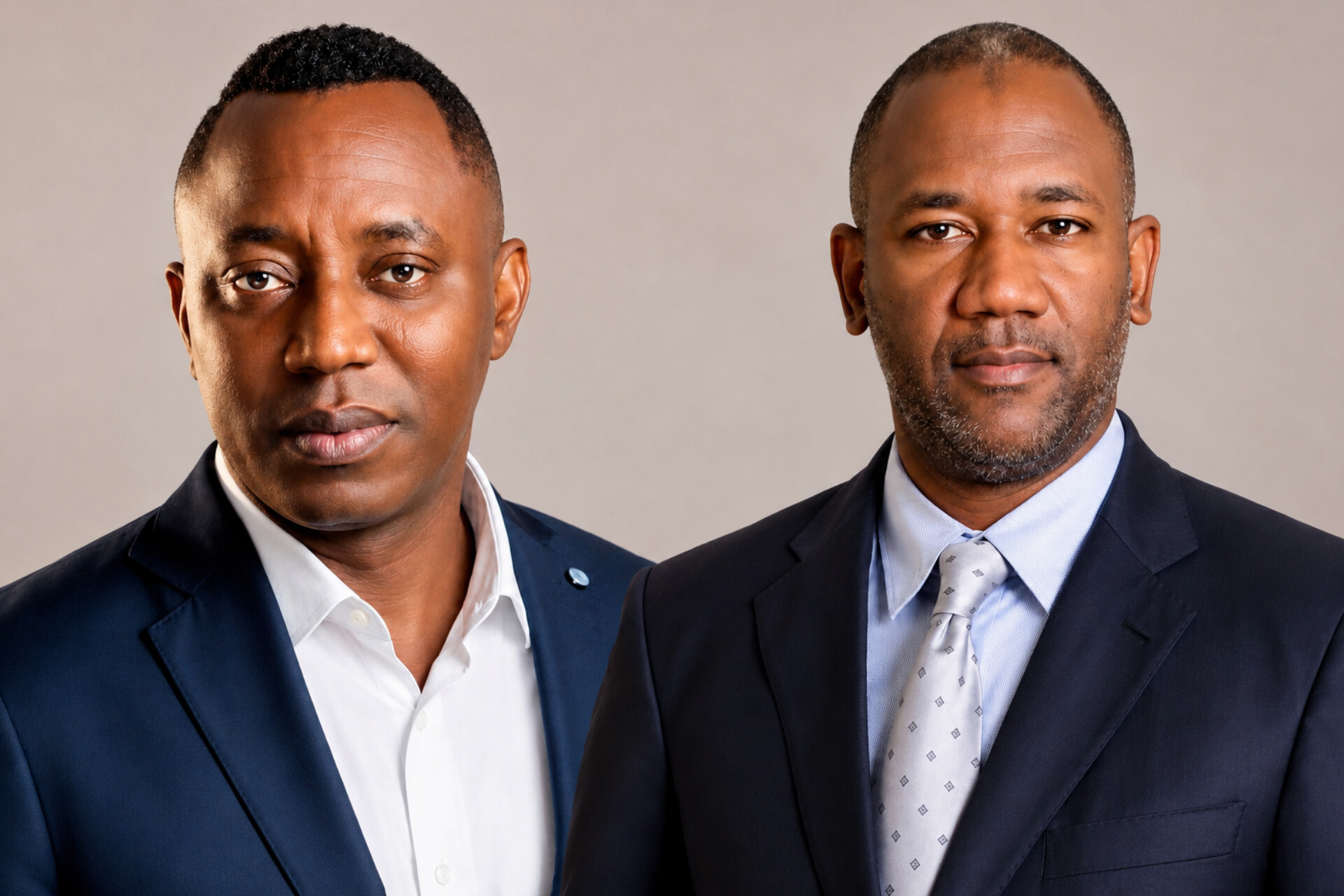
Sowore Replies Datti Over Babangida, Says Compassion Must Not Erase History
Presidential candidate of the African Action Congress (AAC), Omoyele Sowore, has responded sharply to Yusuf Datti Baba-Ahmed following the latter’s criticism of his comments about former military president Ibrahim Badamasi Babangida, arguing that compassion for an elderly former leader should not require Nigerians to forget or soften the historical record of his years in power.
Sowore’s response came against the backdrop of renewed national debate over Babangida’s legacy as the former military ruler marked his 85th birthday on August 17, 2026.
Babangida, who ruled Nigeria from 1985 until 1993, remains one of the most consequential and controversial figures in the country’s political history. His administration introduced major economic reforms, including the Structural Adjustment Programme, while also overseeing a prolonged political transition that ultimately ended with the controversial annulment of the June 12, 1993 presidential election.
The latest exchange between Sowore and Datti has therefore reopened an old national question: how should Nigerians remember former leaders whose records contain both achievements and deeply contested decisions?
Sowore’s answer is uncompromising.
In his lengthy response, titled “My Response to Mallam Yusuf Datti Baba-Ahmed Over My Comments on Ex-Nigerian Military Dictator Ibrahim Badamosi Babangida at 85: Compassion Does Not Require Historical Amnesia,” the AAC presidential candidate argued that age and personal sympathy should not place former holders of public office beyond scrutiny.
Sowore said his criticism was not directed at Babangida simply because the former military ruler had reached the age of 85. Rather, he said, his comments were focused on decisions taken while Babangida exercised enormous political and military power over Nigeria.
The activist maintained that Nigerians have a right to examine the consequences of those decisions, regardless of how much time has passed.
His argument comes at a particularly significant moment because Babangida himself has recently acknowledged one of the most controversial elements of his legacy.
In February 2025, while launching his autobiography, A Journey in Service, Babangida admitted that the late Moshood Kashimawo Olawale Abiola won the June 12, 1993 presidential election. According to excerpts from the memoir presented by former Vice President Yemi Osinbajo, Babangida said that a closer examination of the election results convinced him there was “no doubt” that Abiola had won.
The former military president also accepted responsibility for decisions taken under his administration and described the June 12 episode as one of the most difficult and painful periods of his life. He said that, if given another opportunity, he would handle the matter differently.
For critics such as Sowore, that admission reinforces the argument that Nigerians should continue to examine the historical record rather than allow the passage of time to erase controversial events.
June 12 Remains Central to Babangida’s Legacy
The June 12, 1993 election remains one of the defining moments in Nigeria’s democratic history.
The election, contested primarily by Abiola of the Social Democratic Party and Bashir Tofa of the National Republican Convention, was widely regarded as a credible electoral exercise. The military government under Babangida eventually annulled the election before a winner was officially declared.
More than three decades later, Babangida’s own memoir acknowledged that Abiola had actually won.
That admission has complicated the historical assessment of his administration.
Supporters of Babangida have continued to point to his efforts to initiate a transition toward civilian rule, while critics argue that the annulment of June 12 and other decisions made under military rule cannot be separated from any assessment of his legacy.
Sowore belongs firmly to the latter camp.
His position is that historical accountability should not be weakened by nostalgia, personal relationships or the advanced age of former leaders.
Compassion Versus Accountability
At the centre of Sowore’s response is his rejection of what he sees as a false choice between compassion and accountability.
He argued that Nigerians can recognise Babangida’s humanity without abandoning their right to question his political record.
That distinction is important in democratic societies, where former leaders remain subjects of public scrutiny long after leaving office.
Sowore said he wishes no illness on Babangida but would not participate in what he described as an effort to rewrite history because the former ruler is now elderly.
His argument essentially asks whether growing old should change the way a nation evaluates decisions made by a person when that person controlled the machinery of government.
For Sowore, the answer is no.
He said that if he himself were to exercise political power and make decisions that harmed Nigerians, future generations would have every right to examine his record regardless of his age.
This argument reflects a broader principle of democratic accountability: public office creates a historical record that belongs not only to the individual who held the office but also to the society affected by the decisions taken.
The Babangida-Era Controversies
Sowore’s criticism also revisited several controversies associated with the Babangida years.
One of them is the execution of Major General Mamman Jiya Vatsa, Babangida’s childhood friend and former Federal Capital Territory minister, following a military tribunal over an alleged coup plot in 1986.
Historical records confirm that Vatsa and nine other officers were executed after being convicted in connection with the alleged coup attempt.
The matter remains controversial.
Babangida explained in his 2025 autobiography that investigations had established Vatsa’s involvement and that the decision to act against him involved a conflict between personal loyalty and national security.
However, Vatsa’s family has continued to call for the case to be revisited, arguing that questions surrounding his trial and execution remain unresolved.
For Sowore, episodes such as this demonstrate why historical scrutiny should not disappear simply because former leaders become elderly.
Another major issue is the 1990s oil windfall.
Nigeria received substantial additional oil revenue during the Gulf War period as international oil prices surged. The Pius Okigbo investigation became associated with questions over billions of dollars in oil windfall revenues and their management during the Babangida era. Contemporary and later accounts have cited figures around $12 billion, although the precise characterization and accounting of the funds remain subjects of historical and political debate.
That distinction is important because allegations of personal theft should not automatically be presented as established fact.
The more defensible point is that the management and accounting of the oil windfall generated significant controversy and remain part of the debate over the economic record of the Babangida administration.
The Dele Giwa Controversy
Sowore also invoked the 1986 assassination of journalist Dele Giwa, who was killed by a parcel bomb.
The killing remains one of Nigeria’s most enduring unresolved political mysteries.
There have been longstanding allegations and calls for further investigation into the circumstances surrounding Giwa’s death. In 2024, reporting indicated that a Federal High Court in Abuja directed the Federal Government to prosecute and penalise those responsible for the journalist’s murder, in proceedings linked to human-rights concerns surrounding the case.
However, allegations of direct responsibility for Giwa’s assassination should not be treated as judicially established facts against Babangida.
Sowore’s invocation of the case is therefore best understood as part of his broader political argument about accountability and unresolved questions surrounding Nigeria’s military era.
A Larger Political Argument
Beyond Babangida himself, Sowore’s response also contains a wider criticism of Nigeria’s political establishment.
He argued that political actors who publicly present themselves as fierce opponents can sometimes demonstrate cordial relationships with one another behind closed doors.
He used his encounters with Datti Baba-Ahmed and Peter Obi as examples of what he regards as the gap between political rhetoric and the behaviour of political elites.
According to Sowore’s account, he encountered Datti at a National Peace Committee event and later observed interactions involving senior political figures that he interpreted as evidence that Nigeria’s political establishment is often less divided internally than the rhetoric of supporters suggests.
These are Sowore’s interpretations of events and should be understood as such.
Nevertheless, the point raises a broader issue that has long existed in Nigerian politics: the difference between the fierce political competition displayed during campaigns and the personal relationships that often exist among political leaders outside the public arena.
Political supporters can engage in intense online and street-level battles while their preferred politicians maintain cordial relationships.
For Sowore, this demonstrates why citizens should focus less on personality worship and more on policy, institutions and accountability.
Datti’s Position and the Political Divide
The controversy also highlights a continuing ideological difference between Sowore and Datti Baba-Ahmed.
Both have been prominent figures in Nigeria’s opposition politics, but their political styles and relationships with the establishment differ significantly.
Datti was Peter Obi’s running mate on the Labour Party ticket in the 2023 presidential election and has continued to express support for Obi’s political ambitions ahead of 2027.
Sowore, meanwhile, has maintained a much more confrontational posture toward Nigeria’s political establishment.
His criticism of both ruling and opposition figures has been a defining feature of his political identity. Recent reports show him continuing to challenge government policies and institutions ahead of the 2027 election.
The Babangida controversy therefore reflects a larger disagreement about how political change should be pursued.
Should opposition politics accommodate relationships with figures from the old establishment in the interest of broader political alliances?
Or should opposition movements maintain a clear distance from individuals associated with previous political systems?
Sowore’s response makes his answer clear.
He believes political reform requires confronting the historical record rather than accommodating it for political convenience.
The Importance of Historical Memory
Whatever one’s political position, the debate over Babangida’s legacy raises an important question about Nigeria’s relationship with its own history.
A democracy cannot mature if citizens are encouraged to forget difficult chapters of the past.
At the same time, historical accountability requires accuracy. Controversial allegations should be distinguished from established facts, while legitimate criticism should not become an excuse for careless accusations.
That balance is particularly important when discussing former military rulers.
Babangida’s administration shaped Nigeria’s political and economic trajectory in profound ways. His government introduced economic policies that fundamentally changed the structure of the economy, while his transition programme eventually produced a political system that collapsed amid the annulment of June 12.
His recent admission that Abiola won the election has ensured that the June 12 question remains firmly attached to his historical legacy.
For Sowore, this is precisely why Nigerians must continue asking difficult questions.
He argues that compassion for an elderly statesman should not require citizens to surrender their memory of what happened during his years in power.
That argument will undoubtedly remain controversial.
Supporters of Babangida can point to his military service, political reforms and contributions to the country’s development. Critics can point to June 12, military rule, economic hardship, executions and unresolved controversies.
Both perspectives form part of Nigeria’s contested political history.
Accountability Beyond Political Loyalty
The deeper message from Sowore’s response is that political loyalty should not replace historical accountability.
A former leader can be respected as a human being while still being criticised for decisions made in office.
Likewise, political opponents can be treated with courtesy without surrendering ideological differences.
For a country preparing for another major electoral cycle in 2027, that distinction matters.
Nigeria’s political future will depend not only on who wins elections but also on whether citizens and institutions are willing to examine the records of those who seek power.
Sowore’s argument is that Nigerians should not be required to choose between compassion and truth.
His position is that compassion belongs to humanity, while accountability belongs to public office.
Babangida is now 85 years old, but the events that occurred during his years in power remain part of Nigeria’s national memory.
The June 12 election, the economic policies of the 1980s and early 1990s, the execution of military officers, the Dele Giwa controversy and the unresolved questions surrounding public finances are all chapters that historians, journalists, researchers and citizens will continue to examine.
Whether Nigerians ultimately judge Babangida’s legacy favourably or negatively is a matter for historical and democratic debate.
What is clear is that his age does not erase the record.
And that is the central point of Sowore’s response to Datti Baba-Ahmed: compassion for an elderly former leader, in his view, should never require Nigerians to surrender their right to remember, question and learn from history.
Editorial note: Claims and interpretations attributed specifically to Omoyele Sowore in this report are presented as his views. Historical claims have been cross-checked against available reporting and archival sources, and allegations that remain disputed have been identified as such.
